
Choosing the Right Tool at the Right Time to Speed Development
TL;DR
- Computational modelling and simulation (CM&S) is an FDA-recognized tool with a formal credibility framework for medical device submissions
- CM&S is most valuable when physical prototyping is prohibitively expensive, time-consuming, or dependent on costly tooling
- Model validation is not optional: simulation outputs are only reliable when material properties, loads, and boundary conditions are correctly represented
- StarFish used CM&S to identify design weaknesses and confirm improvements before committing to injection moulding tooling, avoiding costly iterations
- A practical rule of thumb: use simulation to reduce the number of tests required; use testing to confirm your simulations are not misleading you
Designers and engineers today have no shortage of tools to improve designs, accelerate timelines, and meet cost targets. The challenge is knowing what to use and when.
Computational modelling (e.g., FEA) has been around since before the rise of computers, originating in the 1940s out of structural analysis. It has evolved considerably since, driven by advances in computing power. The differential equations in structural analysis or fluid dynamics can be difficult or impossible to solve analytically, forcing a numerical methods approach. Even with faster hardware and improved algorithms, complex simulations remain computationally demanding.
CM&S Is an FDA-Recognized Development Tool
The FDA acknowledges computational modelling and simulation (CM&S) as practical tools for medical device submissions, and has provided guidance and a regulatory framework for their use.
Medical device submission aside, using CM&S is ideal in many cases simply to balance cost against time. Let’s say you are designing a device and want insight on how the device handles repeated use, like flexing during use or repeat drops. Is it fast enough to prototype and iterate to a solution? Sometimes, but the cost and time involved in iterating physical prototypes often outpace what the project can absorb.
Simulation Results Are Only as Good as the Model Behind Them
One thing about simulations is tying them back to reality. This is called model validation and is a critical consideration for relying on CM&S in decision making. The key is understanding what model predictions represent and how accurately they represent the true condition. Are the materials correctly represented? What about loads and degrees of freedom? Does the model constrain elements too rigidly, are the contact surfaces correct, or are parts allowed to move too freely? Just having a simulation pour out results is insufficient. Model inputs can vary results widely – recall that numerical solutions can be dependent on the starting guess and as a result, the wrong inputs may lead to false conclusions. Careful refinement and validation checks are essential to accurate predictions, and product outcomes often depend on them.
If the question at hand is critical, the development pathway should include model validation. So, how do we fit the time to develop the model and the time to validate it into what may be an already tight schedule? An example of where that time is justified is if there is tooling required to produce the parts. Tooling manufacture can be lengthy and expensive, and having to scrap a set of injection moulding tools can severely impact schedules. In addition, new designs may need some aspects of verification to be repeated, causing further delays. If prototypes are exceedingly expensive or time consuming to produce, then simulations may be the answer.
How StarFish Used CM&S to Avoid Costly Tooling Iterations
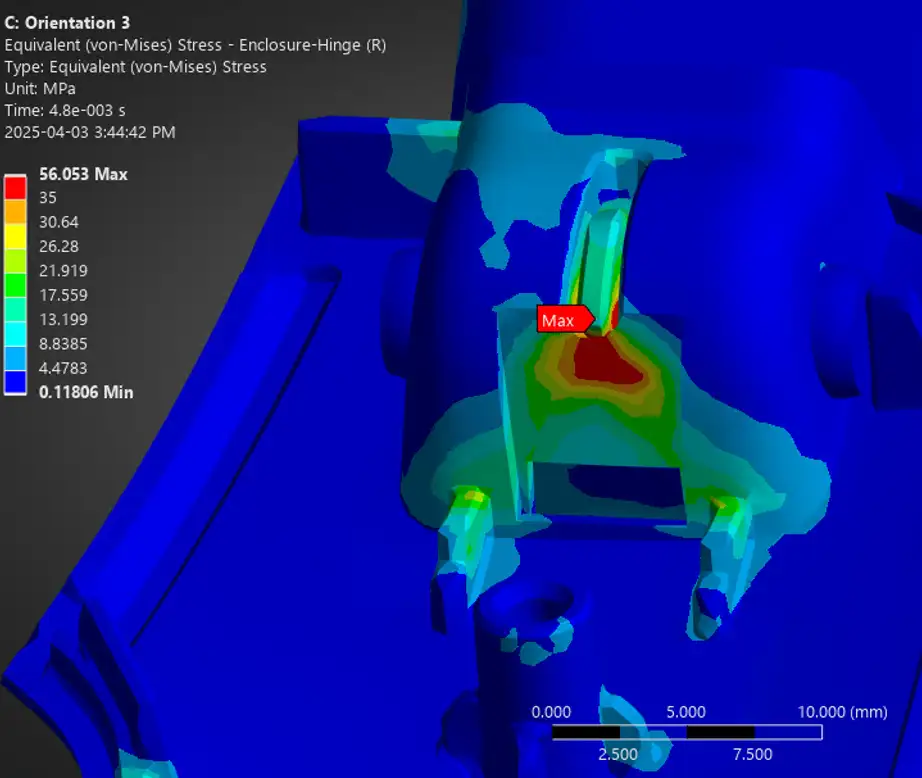
A StarFish team was recently faced with a similar trade-off. Concerned over drop tests (required for IEC 60601-1 for handheld devices) and the reliability of repeated daily use, StarFish turned to CM&S to analyze the full device assembly. During this process, the simulation was able to identify weaknesses in the design during simulated drop tests, as well as areas of potential fatigue concern. The simulation solved multiple orientations simultaneously, surfacing internal regions approaching failure thresholds. While having actual materials would have required tooled components (what we were trying to mitigate), the simulations were able to reveal what physical testing could not. We were able to validate the modelling sufficiently through the use of rapid prototype processes to have confidence in the simulation and the results it was delivering.
Analysing the simulation results, we were able to finalize key design improvements before engaging injection moulders for the project. We were able to change the design, rerun the simulations and show a marked improvement in the results. The tooled product was able to meet the required reliability and drop tests and passed with flying colours.
Without CM&S to highlight risks and help refine the design, we would have had to over-design the product (and therefore miss cost targets or meet the client’s branding and cosmetic requirements), or go through lengthy tooling iterations. CM&S allowed us to cut development time and cost, all while meeting the client’s end product needs.
When to Simulate and When to Build
Like any rigorous testing approach, developing and interpreting a model takes time. CM&S is one development path and must be weighed against alternatives. In many cases, simply building and testing prototypes can give fast and inexpensive results. However, CM&S offers parametric scale (multiple orientations, materials, geometries, etc.), highlights internal and spatial design aspects and risks, enables faster iterations, and supports better isolation of variables for DOE.
A good heuristic:
- Use simulation to reduce the number of tests you need
- Use testing to ensure your simulations are not misleading you
Knowing where CM&S complements physical testing can accelerate development while ensuring your device meets its performance requirements.
Dana Trousil is a StarFish Medical Mechanical Engineer. He has successfully launched many products. He champions prototyping medical devices for all his StarFish projects.
Images: StarFish Medical
Related Resources

The hourly rate is only a starting point when you choose a medical device engineering firm. Learn how to judge team staffing, in-house disciplines, facilities, ISO 13485 scope, and track record before you sign.

Medtech leaders expect connected products to take over their portfolios within five years. Three years of actual FDA clearance filings show a real climb, just a much more gradual one.

Learn why supply chain, process, cost, and quality gaps stall cleared devices, and why they are decided during design.

From skipping the doers to estimating toward a target budget, these ten project estimation pitfalls explain why good estimates go wrong and what to do instead.