

How Aminoglycoside Antibiotics Work
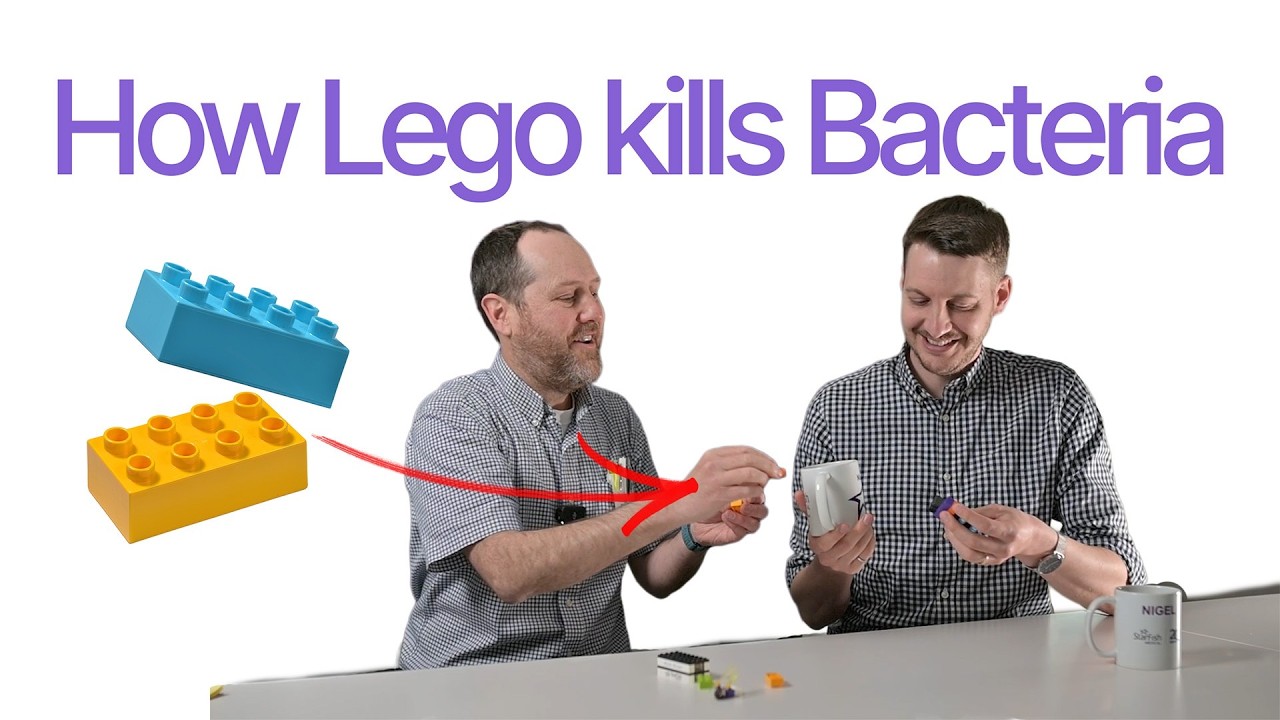
If you’ve ever taken antibiotics, you’ve probably never stopped to ask: how do these actually work? In this episode of Bio Break, Nick Allan and Nigel Syrotuck explain exactly how aminoglycoside antibiotics work and why they’re so effective at killing bacteria. Using nothing more than a Lego figure and a handful of bricks, he makes one of biology’s more complex mechanisms surprisingly easy to follow.
What Are Aminoglycoside Antibiotics?
Aminoglycosides are a class of antibiotics that have been used in medicine for decades. What makes them particularly interesting is their mechanism. They don’t just slow bacteria down, they shut down a fundamental biological process entirely.
Aminoglycosides are polycationic molecules, meaning they carry multiple positive charges. This charge is part of what allows them to penetrate the bacterial cell and reach their target.
How Do Ribosomes Work?
To understand how aminoglycosides work, you first need to understand what a ribosome does. Ribosomes are the protein-building machinery inside every living cell, including bacteria. They read genetic instructions carried by mRNA and use them to assemble amino acids into proteins, one by one.
In bacteria, ribosomes are made up of two subunits: the 30S subunit and the 50S subunit. Together, they form a complete ribosome that slides along the mRNA strand, joining amino acids together to build a growing protein chain. This process, called translation, is essential for bacterial survival. Without it, bacteria cannot produce the proteins they need to function, grow, or reproduce.
How Aminoglycoside Antibiotics Kill Bacteria
Here is where aminoglycosides do their work. Once inside the bacterial cell, aminoglycosides bind directly to the 30S ribosomal subunit. This binding disrupts the normal function of the ribosome in two important ways.
First, it causes the ribosome to misread the mRNA instructions, leading to the production of faulty proteins. Second, it physically blocks the ribosome from completing the translation process altogether, gumming up the works as Nick demonstrates in the episode.
The result is that the bacteria can no longer synthesize the proteins it needs to survive. Without functional proteins, the bacterial cell breaks down and dies. This is what makes aminoglycosides bactericidal. They don’t just inhibit bacterial growth, they actively kill the bacteria.
Watch the Full Bio Break Episode
Nick’s Lego demonstration brings this mechanism to life in a way that a diagram simply can’t. In just a few minutes, you’ll see the 30S and 50S subunits in action, watch aminoglycoside interrupt the process, and understand exactly why the bacteria doesn’t stand a chance.
Watch the episode above and explore more Bio Break videos for short, sharp explanations of the science behind medtech and biotech.
Enjoying Bio Break? Sign up to get new episodes sent to your inbox.
Related Resources

The hourly rate is only a starting point when you choose a medical device engineering firm. Learn how to judge team staffing, in-house disciplines, facilities, ISO 13485 scope, and track record before you sign.

Medtech leaders expect connected products to take over their portfolios within five years. Three years of actual FDA clearance filings show a real climb, just a much more gradual one.

Learn why supply chain, process, cost, and quality gaps stall cleared devices, and why they are decided during design.

From skipping the doers to estimating toward a target budget, these ten project estimation pitfalls explain why good estimates go wrong and what to do instead.
Explore Our Services

Our multidisciplinary teams have all the in-house capabilities to transform your medical device from concept to final product.

Medical device design and development with a commercial launch focus. See how we support clinical trials and facilitate seamless tech transfers.

We help you navigate complex regulatory landscapes to achieve commercial success. Explore our integrated approach to quality and regulatory services.