

Supplier Quality Management for Medical Device Commercialization
TL;DR
Effective supplier quality management requires deliberate effort at every stage of the relationship:
- Supplier relationships in medical device commercialization fail most often due to insufficient upfront due diligence — on financial stability, operational capability, and product understanding — not from problems that emerge later.
- Two-way communication and lifecycle planning from the outset are what distinguish resilient supplier partnerships from transactional ones that break down under pressure.
- Supplier evaluations, when scoped appropriately to risk and followed up promptly, create improvement opportunities for both parties rather than just fulfilling a compliance obligation.
How to develop mutually beneficial supplier relationships
In today’s increasingly complex supply chain sourcing environment, it is common for companies to treat their supplier relationships as opportunities for consistent cost savings. However, truly collaborative supplier quality management does not have to be a zero-sum game. With a little planning and communication, you can develop mutually beneficial supplier relationships that can result in wins for both you and your suppliers.
This eGuide covers the basic elements to implement a Modern Medical Device Commercialization supply chain quality strategy.
Understand your potential supplier
The first step to developing a winning supplier relationship, is to understand your supplier and their capabilities, with the goal of ensuring that they are appropriate for your business and do not generate an undue level of risk. Even if potential risks are identified, it is vitally important to address them at the beginning of the relationship, so plans can be made to mitigate the risks before any product or service delivery occurs. The effects of any risk events will be much greater the further into the relationship you proceed. In some cases, the potential impacts can be so large it may be preferable to decline the commencement of the relationship rather than proceed with a first order. It is vitally important to do your supplier homework!
Financial Capability
Is your potential supplier a small family-owned distributor, or are they a large multinational OEM with multiple plants in different countries? Each could have vastly different ways of managing accounts payable. What impact are your requirements going to have on their inventory costs, cash flow, and other financial metrics? Are they willing to commit to ‘locked in’ contract pricing strategies, with escalators for material costs, freight, or other factors? Or are they only willing to commit to pricing on a shipment-by-shipment basis?
Even if a potential supplier is reluctant to share their ‘numbers’, make sure you take these details into consideration when planning your sourcing strategy. There are two reasons for this; firstly, you want to ensure your requirements are appropriate for the scope of product under purchase, and secondly by being too rigid and inflexible on requirements you may be disqualifying otherwise competent suppliers. Some may not be willing to take on the risk of dealing with large cash flow impacts without flexibility on terms, progress billing or other mitigation strategies.
Operational Capability
Can be considered the ability of the supplier to get the product to you on an ongoing basis in a way that fulfills your criteria. This can vary widely depending on the nature of the product being sought and how and where it will be used. For example, are you looking at:
- a multi-site supply arrangement consisting of a large volume of product with regular ongoing shipments to one or more destinations in different geographical locations, or
- a tight turnaround of a relatively small number of highly engineered custom components for a product development initiative, which are only ordered on a project-by-project basis and may require design changes between subsequent orders?
Both of these examples are common in different industries, and knowing the industries that your potential supplier operates in will be helpful in determining if they are good candidates to provide the product in a way that meets your needs.
Consider freight and logistics impacts – from where and how will the product be getting to you? Are timelines the critical factor, or is cost? Are there cross-border implications such as customs, duty, or other taxes to be factored into the cost of the landed product? Is there any specialized paperwork that the product will require to get across the border? How does the product need to be packaged to ensure it arrives safely at your destination?
As an illustrative example, consider seeking a quote for a relatively small volume (say, 100) of custom injection molded parts. A large supplier who primarily operates a high volume, low complexity injection molding plant close to your facility may choose to produce your products not from the closest plant, but from a smaller plant further away that is set up to perform custom work of this sort. This may have cost implications, both from the perspective of the unit cost and the shipping cost, plus there is the added risk of a longer shipment lead time. All these factors should be taken into consideration when evaluating your supplier’s operational fulfilment strategy.
Make sure your supplier understands your product
The amount of information you will need to provide about the potential product will vary depending on its risk level and degree of customization. For example, if you are looking at sourcing custom one-off items from an additive manufacturer or a large batch of custom injection molded parts, then you will need to provide detailed information such as parts drawings, material specifications, reference dimensions and CtQ (Critical to Quality) information such as critical dimensions and dimensional acceptance tolerances. On the other hand, for sourcing a commercially available ‘off the shelf’ component, all that may be required could be an OEM part number and a quantity, as dimensional information is already published through other sources (product line handbook, line card, website, etc.).
However, don’t assume that just because you provide the necessary information, that your supplier will automatically understand what you need. Even in a technical buying scenario, a business development or technical sales team may not fully appreciate the impacts of the product you are seeking to purchase on their business operations. It is of benefit to both parties that time is taken at the start to ensure this understanding. Otherwise, sales decisions made based on incorrect or incomplete understandings, may expose one of the parties to an inordinate level of risk as the relationship progresses, and that party may decide to end the relationship due to that risk. Once that happens, the purchasing team is back to the beginning, with more supplier sourcing work to do and deadlines to meet. In order to avoid that scenario, it is important to assure yourselves that the information is understood before proceeding.
Begin with the End in mind
In today’s fast moving manufacturing environment, product life cycle developments can have a huge impact on your sourcing strategy. Product stewardship regulations such as EPR, REACH or RoHS can require product design changes. Planned obsolescence or other end of life concerns may necessitate multiple iterations of the same product in your procurement pipeline at the same time. Be sure that both you and your suppliers understand the expected life cycle of the sourced product in question, and how the product requirements are planned to change over time.
Communicate
Once the relationship has been established, understand that the best communication will now flow both ways. For certain higher risk regulated industries, documenting both supplier and customer responsibilities, deliverables and expectations at the outset in a formal supplier agreement or quality plan is a highly recommended practice. It will minimize the misunderstandings as the relationship progresses.
Once the relationship moves into the transactional phase, where orders are requested and products or services are delivered, effective and consistent communication becomes very important. Be prompt and courteous but provide as much notice as you can about timelines, upcoming orders, deadlines and other order variables. If your supply strategy is complex and you have the necessary controls in place, consider utilizing higher level strategies like forecasting or demand planning and sharing these with your suppliers to help them plan to meet your requirements.
Too many supplier relationships suffer because of the perception that the communication is “one way”. The buyer asks and asks, but everything is urgent and last minute, and the supplier is often put on the defensive trying to fill orders and keep their customer happy, sometimes to the detriment of their other customer relationships. Providing forecasts or other guidance in advance to help the supplier plan their operations goes a long way to improving the health of the customer/supplier relationship.
Evaluate and provide feedback
Supplier evaluation is a necessity whether required from an internal risk management program, regulatory requirements flowing from external standards like ISO 13485, or just sound business practice. Executed properly, a supplier assessment program can benefit both parties, uncovering opportunities for improvement and increasing the trust between all involved. On the other hand, if performed haphazardly or inconsistently without clear motives, communication and expectations, evaluations can actually harm this relationship.
Here are some things to consider:
Understand the purpose
From a supplier perspective, you are taking up their valuable time, so you need to be clear about the scope, expectations and purpose. Beyond simply fulfilling your assessment obligations, the purpose of a proper evaluation is to uncover potential improvement opportunities for both parties, leading to cost savings, quality improvements and other gains for all involved.
Know your history
When evaluating a supplier, be sure to include a review of recent orders. On time delivery data, incoming inspection results, NCRs (Non-Conformance Reports) or SCARs (Supplier Corrective Action Reports); all supplier related historical information should be included when evaluating a supplier. In particular, actions raised with a supplier in the past that have been resolved to the satisfaction of both parties can be highlighted to demonstrate wins on both sides.
Scope your evaluation commensurate with the risk
Whether a quick historical order review or a full-blown supplier audit, it is important that the scope of the evaluation is appropriate for the risk level of the part or service provided by the supplier. For those critical suppliers on your evaluation list, consider a system of regular feedback (every 6 months/annually) coupled with a more in depth onsite or virtual audit every two to three years, or
perhaps more frequently if the supplier does not have an externally audited QMS.
Audit planning tips
If you do end up planning an audit, consider the following:
- Be clear about the expectations and deliverables – make sure that the supplier understands and can see the value in holding the audit. After all, if you are struggling to provide adequate justification, then why are you doing it?
- Plan and provide the audit scope – do you focus on the order process, or the product itself? Are you including other non “order fulfillment” aspects of the supplier’s operations within the scope, such as continuous improvement or training?
- Schedule time for walkarounds and freeform discussion – so much of the learning that takes place during audits can happen in the conversations between official tasks; if your supplier is willing to share their concerns, thoughts and perspectives, you may find you learn more about the ‘true’ state of the relationship from those conversations than you do through the official audit program.
Communicate results promptly and openly
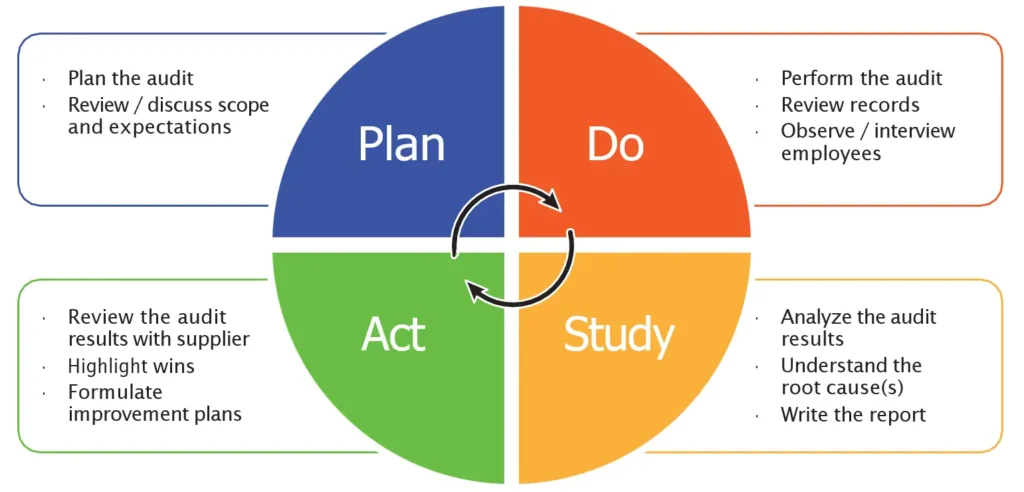
Sometimes, suppliers will host an audit and then wait weeks or months for the official report. Make sure you take time to follow up with the final report within a week at most, and schedule time either in person or virtually to present the results, discuss your critical findings (if any) and provide time for the supplier to share their perspective. Even for regular evaluations, be sure and give the supplier the opportunity to provide their thoughts and consider their feedback openly and honestly. After all, despite the unavoidable power dynamics between customer and supplier, there are plenty of opportunities to learn on both sides; one simply has to be open to receiving.
Celebrate wins
So now you have developed and brought on board a new supplier. Orders have been placed, and the product is coming in the door. How do you show both your employees and your supplier gratitude for all their efforts? Consider that small but creative efforts at showing appreciation can be highly effective. Some suggestions: sponsor a hole at the supplier’s golf tournament; pay for an employee pizza lunch; send your supplier local event tickets (pro sports, concert events) for use in an employee raffle. Recognitions don’t have to be big productions, but if they’re performed sincerely and with gratitude, they can help to keep teams engaged and focused on achieving your collective goals.
Strong Supplier Relationships Are Built, Not Assumed
Supply chain quality management is often an overlooked aspect of the strategic sourcing process. Utilizing controls appropriate to the risks involved, carefully planning the product lifecycle, and ensuring prompt communication, you can develop robust supplier relationships, resulting in a consistent supply of high-quality goods and services and ensuring wins for both parties.
How to develop mutually beneficial supplier relationships
Your Supplier Questions, Answered
What is supplier quality management in medical device commercialization?
Supplier quality management is the process of evaluating, onboarding, and maintaining supplier relationships to ensure a consistent supply of components and services that meet regulatory and quality requirements. In medical device commercialization, it is a critical and often underestimated part of the overall supply chain strategy.
How do I know if a supplier is appropriate for my medical device company?
Start by assessing their financial stability, operational capability, and experience with products similar to yours. Even if risks are identified early, they are far easier to mitigate at the outset of the relationship than after orders have been placed and production has begun.
What should I include in a supplier agreement?
At minimum, a supplier agreement should document responsibilities, deliverables, quality expectations, and escalation procedures for both parties. For higher-risk regulated industries, a formal quality plan is also recommended to minimize misunderstandings as the relationship progresses.
How often should I evaluate my suppliers?
Evaluation frequency should be commensurate with the risk level of the supplied component or service. A practical approach is regular performance reviews every six to twelve months, coupled with a more in-depth audit every two to three years — or more frequently if the supplier lacks an externally audited quality management system.
What are the most common reasons supplier relationships fail?
Most failures trace back to insufficient upfront due diligence, one-way communication where the buyer drives all urgency, and evaluations that are treated as compliance checkboxes rather than improvement opportunities. Addressing all three proactively significantly reduces the risk of relationship breakdown.
Sean Mitchell is a former StarFish Medical QA/RA Specialist. A mechanical engineer by education and a systems engineer at heart, Sean Mitchell is a manufacturing and quality professional with over 20 years of diverse operational experience in industries including plastic film extrusion, fabricated metal production and food and beverage packaging. At StarFish Medical he works with quality assurance, manufacturing and supply chain teams to optimize business processes, identify best practices and make improvements within the supply chain and manufacturing. Sean’s Quality Management projects and expertise include developing and improving Quality Management and Supply Chain systems to improve data sharing, traceability and other functional capabilities.
Related Resources

Inventory Risk Management is an important factor for long-term growth and competitiveness in the medical device industry. Learn five key areas to watch.

Medical Device Supply Chain Strategies offers supply chain strategies useful for each product development phase.

In today’s increasingly complex supply chain sourcing environment, it is common for companies to treat their supplier relationships as opportunities for consistent cost savings.

Five ideas that help kick-start the creation of a Strategic Medical Device Supply Chain during NPI (New Product Introduction).