

Medical Device Project Estimation: When to Use a Gut Feel, ROM, or Detailed Estimate
TL;DR
- Choosing the wrong estimate type for the situation wastes effort or undermines trust — matching type to purpose is a core project management discipline.
- A gut feeling (WAG) is valid for order-of-magnitude decisions only; using it to approve work or set budgets creates real risk downstream.
- A ROM estimate (-25% to +75%) is the right tool for formal stakeholder alignment, go/no-go decisions, and budgetary goal-setting.
- A detailed estimate (+/-10%) requires enough time and space to produce properly — a rushed detailed estimate is not actually a detailed estimate.
- Estimate types can be combined (e.g., detailed near-term, ROM for the far end) to match the uncertainty horizon of the work.
This is one of five blogs in a series about program estimation. In the lead article, we walked through a typical scenario using a four-step process: align on scope and surface risks early, frame a range to get a decision, build a detailed plan, then lock the near-term and begin moving in a rolling wave. Different steps in that process referenced different estimate types, which are elaborated on here.
Choosing the right estimate type for your purpose matters: one that is too high level or inaccurate will undermine trust and weaken the program, while one that is too detailed for the situation wastes effort.
The further out you’re estimating, the more uncertainty you will encounter: developing a detailed plan for product launch before you’ve designed a prototype is not a good use of time. To mitigate this, your estimate can also combine types (e.g., detailed for the short term and ROM for the end).
Here are the main types of estimates as I see them:
Gut Feeling Estimate: Know When a WAG Is Enough
What: Affectionately called a WAG (wild ass guess) or guesstimate at times, this is an estimate born from past experience. It should focus on order of magnitude only: “this is a few days, this is a few weeks, this is a few months”, etc. A range is appropriate here too: “could be a few weeks to a month, depending on a few things.”
How: A gut feeling should be producible on the spot, after asking a few questions. For medical devices, a few useful ones: intended use, expected architecture, production volumes, and end objective.
Purpose: A gut feeling should only be used to decide whether it’s appropriate to proceed to a more detailed estimate. If a stakeholder wants a new feature and thinks it might be a couple of days to implement, then learns it’s actually a few weeks, they might stop the process (and not proceed to a more detailed estimate). Similarly, if a program is far more expensive than the budget allows, that program might get shelved.
Contraindications: A gut feeling should not be used to approve work (unless it’s tiny or low risk) or set funding/budget targets. Everyone should understand that a gut feeling is, indeed, a wild ass guess, and treat it appropriately: the only possible negative outcomes from a gut feeling being wrong are a few days wasted making a ROM estimate (underestimated), or a lost opportunity (overestimated).
Rough Order of Magnitude: The Right Tool for Formal Alignment
What: A ROM estimate is defined as -25% to +75% by PMBOK. In practice, different people use the term ROM in different ways, but all ROMs have a few common features: a wide range, limited details, and some broad assumptions.
How: There are a few ways to produce a ROM estimate, such as historical comparisons or full-time equivalent (FTE) effort loading. A bottom-up estimate can work here if it’s kept at a high level (e.g., “design chassis,” “assemble chassis,” as opposed to a granular level, e.g., “add tolerances,” “drawing review meeting”). Note that a ROM estimate should take longer than a Gut Feeling but be much faster than a Detailed Estimate.
Purpose: A ROM should be used for formal alignment. Stakeholders should be able to trust that a ROM estimate is accurate (i.e., the true timeline or cost will fall within the range). Approval of a ROM estimate can unlock a few next steps: decision between options, go/no go on the project, setting budgetary or funding goals, or similar.
Contraindications: A ROM estimate is not a detailed plan, and thus, can’t be used as the sole approval for a large project. If it matters where in the range the project lands (i.e., at -25% it is approved, but at +75% it’s not approved), then a more detailed estimate is needed. Also, a ROM estimate should be centered around a reasonable center: if every single one of your estimates turns out to be closer to the +75% mark, you’re not doing anyone any favors.
Detailed Estimate: When Precision Earns Its Cost
What: A detailed estimate carries +/-10% confidence in cost and schedule, which is usually enough to support a firm (fixed-price) quote.
How: There are a few ways to produce a detailed estimate, but to achieve that confidence you’ll lay out all the steps, estimate cost, labour, and time for each, and build up to an overall estimate with assumptions. A useful guideline: expect to spend a couple of percent of the program size in planning (e.g., for a 1,000-hour project, expect 10-50 hours, or 1-5%, depending on scope, risk, and complexity). Another tip is to ensure that assumptions made in previous estimates (e.g., a ROM) are still valid as you gain further clarity.
Purpose: To agree on scope and get approval to begin work.
Contraindications: Detailed estimates should not be used for deciding between options (this can usually be done with a ROM). Also, a detailed estimate requires enough time and space to produce properly: a rushed estimate isn’t a detailed one.
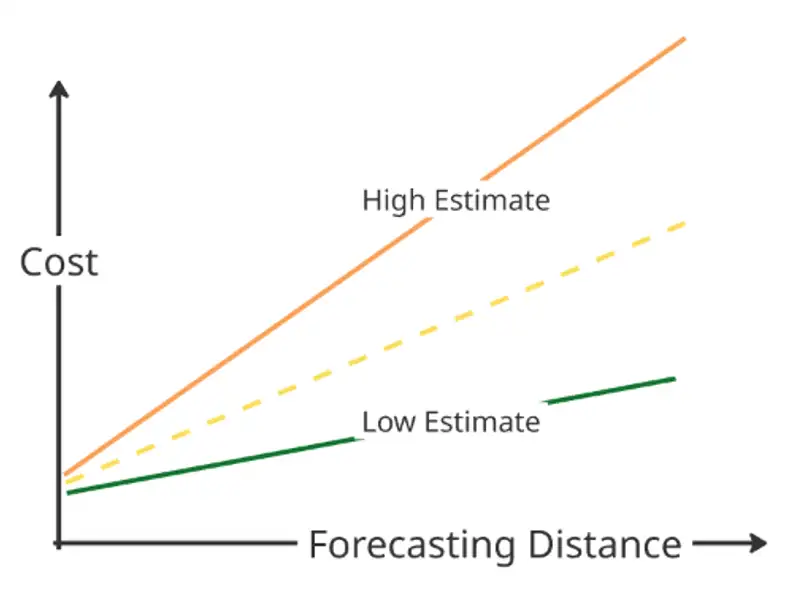
Bonus note: You might also consider drawing a line in your detailed estimating to differentiate between far-out planning (which includes unknown unknowns) and near-term planning (mostly known unknowns), applying a greater risk factor to the farther-out estimates (see image above). Either way, the general process and outputs are the same.
A Few Notes on Skipping Steps
Do I need to go through all 3 steps every time? No. A Gut Feeling might be appropriate as the only estimate for a tiny amount of work (hours to days), or a ROM might be fine for a small amount of work (a few days to a couple of weeks). It depends on your budget and how busy your resources are. Or, if a new scope of work is extremely similar to past scope of work, you might feel confident in reusing existing data quickly.
You might also skip a ROM Estimate if the program is guaranteed to go forward: e.g., “I need this feature, no matter if it takes a couple days or a couple weeks (which of course, would be based on a Gut Feeling), so get planning.”
Nigel Syrotuck is a StarFish Medical Project Engineer and frequent guest blogger for medical device media including MD+DI, Medical Product Outsourcing, and Medtech Intelligence. He works on projects big and small and blogs on everything in-between.
Images: Adobe Stock
Related Resources

Early phase concept development is a weird part of a project lifecycle. It is often the most exciting phase, because the team is exploring possibilities, generating new ideas, and turning a fuzzy opportunity into something real.
Clinical prototypes must not only function as intended, but also be manufactured, documented, and supported in a way that satisfies regulatory expectations and clinical realities.

Choosing the right project estimation approach can make or break a medical device program. Learn when to use a gut feel, rough order of magnitude, or detailed estimate to balance speed, accuracy, and risk.

This blog provides an overview of the major steps involved in estimating cost and schedule. Though this is specifically based on medical devices, similar projects across a variety of industries will follow similar steps.