

Optimizing Medical Device Product Definition
TL;DR
Medical device entrepreneurs often underestimate how many interdependent factors must be resolved before engineering begins in earnest:
- The Pathfinder process evaluates eight critical dimensions of commercialization readiness — technology assessment, value chain, human factors, intellectual property, regulatory pathway, consumable strategy, reimbursement, and manufacturing — each of which directly constrains the others.
- Healthcare reimbursement is based on procedures, not devices, meaning a device’s commercial viability depends on how central it is to a billable procedure and whether it can demonstrate measurable clinical or economic value to payers.
- Decisions made at the product definition stage, including architecture choices, indications for use, and consumable strategy, compound throughout development and are far more costly to reverse after detailed design begins.
Introduction
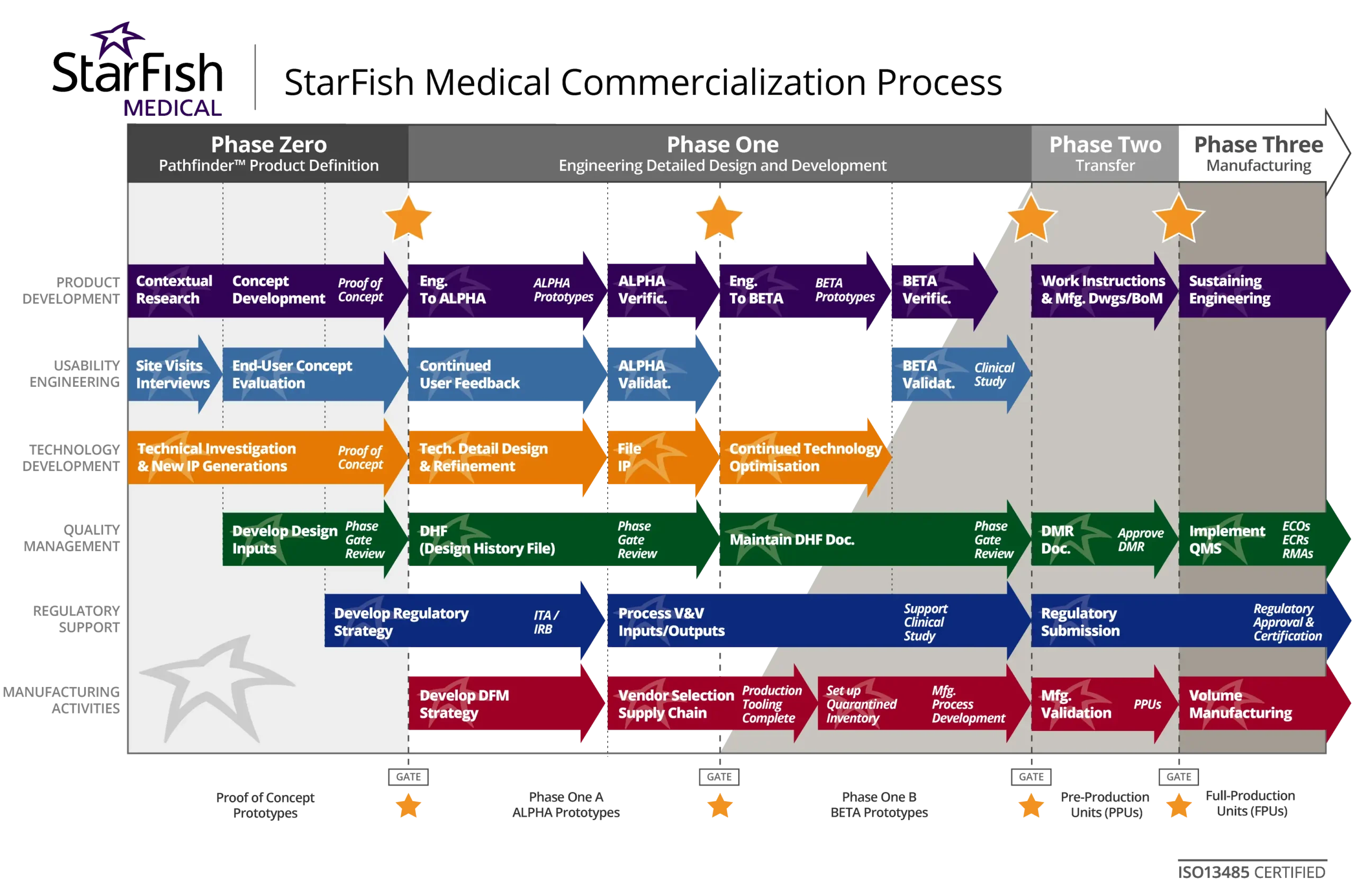
Over the years, StarFish Medical has worked with a lot of entrepreneurial individuals and their ideas for exciting new medical devices. Our experiences led to the Pathfinder™ process, which assists the entrepreneur in gauging their new technology commercialization readiness during the Product Definition Phase of the Commercialization Process (see chart below). This white paper touches in more detail on the questions that we ask when performing a Pathfinder Review and discusses some of the related issues.
Pathfinder Phase of Development Process
Technology Assessment
Developing medical devices means following a process. An engineering prototype with a schematic and source code can only be considered ‘proof of concept’, and is not a product. Formally assessing your technology for medical device suitability is an important step on realizing your product.
The first step is to understand what the product requirements are – these usually comprise of specific customer requirements (such as use cases), performance requirements including weight, dimensions, lifetime etc., and any regulatory requirements for safety.
From this we can explore the preferred system architecture – purely mechanical devices may not need software, but software is a heavy proportion of many devices so the split between software/hardware must be explored for the associated trade-offs and benefits. In particular, identification of architecture modules (both software and hardware) critical for safety or performance should also be identified, as they will need special attention later.
Once the product requirements and system architecture are available, a formal Hazard Identification and risk analysis can be performed. The hazard identification formally steps through the list of hazards to patient and operators as specified by the risk management standard and determines whether they are applicable or not. If not, then a justification is made why not. If they are, then the various permutations of how that hazard could cause harm to a patient or operator are translated into the risk analysis. The risk analysis then scores the likelihood of that harm, and if excessive, mitigations are implemented either as specifications or architecture updates.
Once the risk analysis indicating required mitigations, product requirements and system architecture is defined, then the detailed design and schematics and software coding can begin to implement the requirements.
Value Chain and Margin
Generally, the retail price point is determined by some combination of market acceptance, reimbursement and value proposition — or how your device can reduce costs by saving time, resources or improve outcomes with better performance. Once the retail price point is determined, the distribution method must be clearly understood. It is extremely uncommon for an inventor/entrepreneur to build a company with a national sales and distribution network; even less so a global sales and distribution network.
Traditional distributors, typically with local sales offices employing local area representatives who call on and visit hospitals and clinics, need a high margin to support such a large infrastructure. A common cry from the naïve is “we will sell it on the internet”. Although internet sales have low start-up costs, this approach works best for well-known brands, whereas a new device from a new company still requires a lot of marketing activity. Catalogue retailers are somewhat of a middle ground, but again you must actively drive marketing as the rep employed by the catalogue company probably has a traveling sales bag with similar products to yours already in it.
Human Factors
Human factors are often overlooked by engineers as they design a device how they would use it, not how the target operator would. However, the FDA now views use error as predominantly a device flaw.
Also important is the effect usability has on the business case. For example, a recent touchscreen ultrasound scanner was poorly accepted by end users. They were more comfortable having one hand using tactile knobs and sliders and the other hand on the assessment site. This enabled them to avoid looking where to touch the screen and maintain focus on the viewing screen.
The key point is to map out what your operators are doing – the so called “use cases”. If you have a device intended for home use and professional use, then you will need two sets of “use cases”. From this, you must identify the frequently used functions, which are then assessed for operator error and foreseeable misuse.
Prototype device concepts are developed, and should be reviewed by typical operators in a focus group session before commencing to detailed design.
It is quite common to have early mock ups, block models or weighted rapid prototypes to get a better feel. The user interface should also be reviewed – whether it is software, buttons, knobs or handles – and the placement of the various components confirmed. Most people have viewed a web site which takes too many clicks to get to where they want to go – the same principle applies.
Once the device is developed, it must be validated for usability by formally documenting that the device is used by the users in the way intended, and is fit for purpose. This is often performed using questionnaires and actors in a simulation. Alternatively, prototype devices may be evaluated as an adjunct to a clinical study, depending on the device type and risk of harm to the patient from operator error.
Finally, the instruction for use must also be validated, particularly for devices intended for home use. Similar to usability validation, but usually performed in a simulation, operators are given the chance to review the instruction manual, use the device, provide feedback and ask questions on areas that are unclear, indicating where the manual needs extra work.
Intellectual property
If you are discussing intellectual property with potential collaborators before a patent is filed, then a Confidentiality Agreement must be in place in order to prevent disclosure affecting your patents. This can be very difficult in the academic world, and must be finely balanced with the academic imperative of contributing to knowledge by disseminating papers and attending conferences, but only after the provisional patent is filed.
Patent Strategy is the second key item: An invention intended to patent globally can cost hundreds of thousands of dollars to patent and maintain over the life of the patent. Hence, selective patenting is key. A common strategy is the ‘cost deferred’ approach whereby a Patent Cooperation Treaty (PCT) submission is used to maintain a priority date while pushing patent translation and grant costs as late as possible. Many countries are signed up to the PCT with a few exceptions below.
The PCT was developed to give the inventor confidence on patentability without having to file in multiple countries, then discover there is an inventive step issue. This is why it is highly recommended to file a PCT and get the international search report and written opinion before filing nationally. Note there are similar treaties available for other jurisdictions, such as the Eurasian Patent Procedure for the Russian Federation and associated ex-Soviet Republics, and the Gulf Cooperation Council patent for Saudi Arabia and other Persian Gulf states.
However, if time to grant of patent is more important, then selected national filings could be made sooner rather than later, such as US Provisional patent application and European Patent application, instead of or in addition to the PCT. An even simpler approach is just to patent and sell products in the US, as this is the largest single developed healthcare market with a transparent regulatory body.
Your patent strategy should generally try to allow for continuations or divisional patent applications – ideally the preferred embodiment in your PCT should be full of material just waiting to be patented. This provides the opportunity for yourself or a potential acquirer to steer the invention in a particular direction some troubling IP is discovered, provided it is within the scope of the original invention.
Freedom to operate must also be discussed. This has another name – infringement, which most people try to avoid. Remember that your freedom to operate status is for a current snapshot in time, hence, since costly, the analysis should only be performed when absolutely necessary, such as in late discussion with a potential acquirer. Given that willful infringement is awarded 3x punitive damages in a lawsuit, it is advisable to discuss the likely outcome in camera as privileged information with your patent attorney, before any reports are written.
Regulatory
Regulatory Affairs is a whole expertise in itself, and can be daunting to those new to medical devices.
StarFish’s Regulatory checklist touches on the main things to consider. The Pathfinder process can help develop and fill in areas which are currently lacking, such as the Indications for Use, which is vitally important in defining a product’s regulatory pathway. For example, under Health Canada guidance, an Oximeter intended for spot checking home use is Class II, but if it is intended for continuous monitoring in a recovery room is Class III, while an intracardiac Oximeter is Class IV. All use the same underlying technology, but have three different risk classifications based on indications for use.
Consumable Strategy
Most investors require recurring revenue through the use of consumables or disposables. This used to be known as the razor blade model, but may now be more commonly known as the print cartridge model. For it to be well tolerated by end users, it must also enhance the functionality of the device, unless you are using a ‘pay per use’ model.
As with most development projects, the more money that is available for up-front development means the lower the consumable per unit cost will be. Investing more time and resources in analysis of multiple design configurations for manufacture and product quality usually reduces manufacturing costs, field operation, and repair costs. However, when raising development funds, a tradeoff is required.
Reimbursement heavily affects consumables. For example, if your spirometry device is an improved spirometer, then Medicare reimbursement is ~$35 since:
- the equipment cost is relatively low (<$5,000)
- the time taken to perform the procedure is relatively short (<15 minutes)
- a moderate level of operator training required
The consumable must therefore only be a few percent of the overall reimbursement cost, such as a disposable mouthpiece for hygienic reasons as this saves operator time cleaning the equipment. The operator justification here is the patient would prefer not to reuse the same mouthpiece another patient had already used.
Compare this with lower extremity bilateral Duplex ultrasound scan of the legs, which is ~$195 since:
- the equipment cost is high ($30,000+)
- the time taken is significant (40+ minutes)
- expert ultrasound operators are required (Bachelor’s degree)
If your device enables lower extremity ultrasound scans to be performed more quickly or with less highly trained operators, then this could justify an increased consumable cost of perhaps ~10%. Care must be taken to ensure you are meeting reimbursement requirements (such as using appropriately trained operators), discussed below.
The control of unauthorized consumables is also important. This may not be required early in the launch phase of your development, but should be considered once volumes begin ramping up. In the spirometer example above, it is quite difficult to prevent another manufacturer from providing disposable mouthpieces for a lower cost. Consumer electronics developers had similar issues, and there are now families of authentication products available which are designed to control the supply of laptop batteries, print cartridges and even white cell phone accessories, that may be employed to also control medical products.
Reimbursement
Generally, healthcare is reimbursed on procedures, not devices. If your device is fundamental to a procedure then you have a strong marketing case. If it is peripheral to the procedure then your case is less strong, which affects your value chain and margin.
Reimbursement is highly market dependent, but we shall discuss the largest market with a single regulatory authority – the United States. Here, procedures are defined by common codes and Medicare publishes guidelines on what are acceptable modalities for performing those procedures. Local insurance carriers tend to follow Medicare, but may be more restrictive. For example, some procedures are disallowed when performing a similar procedure on the same day, and in that case you need to incentivize the user for using your device as opposed to the similar procedure.
Other markets have similar or more restrictive requirements and may be policy driven. For example, policy in some jurisdictions dictates that all non- critical assays are performed in a robot testing warehouse. Here the tests are performed on a 24 hour basis and results available within 1 day electronically. Attempting to launch a POC hand-held IVD in that jurisdiction would be extremely difficult, but if your device was essential for a faster/ cheaper robot warehouse, then you may be more successful.
Other markets may have different requirements. The key is in helping clinicians meet metrics. For example, in France the family physician is paid a set amount for each patient – any extra testing performed effectively reduces profit. In the UK the Quality and Outcome Frameworks (QoF) incentive scheme drove sales of spirometers in the family physician or General Practitioner’s office. Understanding what these schemes are and how they can affect your product effectively forms the reimbursement strategy.
Manufacturing
The right manufacturing partner is almost as important as the right development partner. Even prototype devices intended for use in a clinical study should be assembled and tested under a recognized quality management system in order to reduce risk of harm to participants in the study. People often use the expression ‘design for manufacture’, but fail to qualify what volumes are being discussed.
Although part of the design brief is to design for manufacture, the more upfront development then the lower the manufacturing costs can be. Therefore, planning to perform one or two cost reduction redesign exercises as volumes increase is a good idea. Often switching suppliers is required. This forms part of your manufacturing strategy – who will manufacture what volumes, where and when. A plan might be: North American manufacturing for low volume now, Mexico/ Puerto Rico for medium volumes in the next two years and south-east Asia for high volumes in 5 years’ time.
Finally, parts availability should also be part of your manufacturing strategy. For example, graphic displays are popular but problematic for medical devices. Off the shelf units with long lifetimes are generally expensive at $100, but can be bought in volumes as low as one or two. Graphic displays used in Satellite Navigation units are low cost, but only available as surplus (i.e. the manufacturer had some left over). Placing an order for 10,000 graphic displays with a Hong Kong manufacturer would guarantee low cost and long term availability, but you may have to warehouse the units. And the cost may be $250,000 just for the display, which needs to be financed somewhere.
Interdependencies
In an ideal world, the eight Pathfinder points would be equally split into technical and business related fields. For example, Value Chain and Manufacturing are traditionally considered business issues.
| Business | Technical |
|---|---|
| Consumable Strategy | Intellectual Property |
| Value Chain & Margin | Regulatory |
| Reimbursement | Human Factors |
| Manufacturing | Technology Assessment |
However, each item is heavily dependent on the others. For example, the Consumable strategy may be affected by IP and Human Factors – a useful consumable that is novel so it can be patented but is also free to operate. The Technology Assessment is heavily dependent on the consumable, but also on the Manufacturability of the consumable, as a consumable price point of $1 is required for the business case, but the capital costs of the manufacturing equipment might be hundreds of thousands of dollars.
The only advice here is that a holistic approach is often required for device development. F. Scott Fitzgerald once said,
“The test of a first-rate intelligence is the ability to hold two opposed ideas in mind at the same time and still retain the ability to function.”
It is the responsibility of the entrepreneur to keep these opposing ideas in mind, manage the development process and deliver a useful, useable, and efficacious device.
Is Your Medical Device Concept Ready to Commercialize?
Your Product Definition Questions, Answered
What is the StarFish Medical Pathfinder process?
The Pathfinder process is StarFish Medical’s proprietary product definition review that helps medical device entrepreneurs assess their commercialization readiness before committing to detailed engineering. It evaluates eight interdependent dimensions: technology assessment, value chain and margin, human factors, intellectual property, regulatory strategy, consumable strategy, reimbursement, and manufacturing.
Why does product definition matter before detailed design begins?
Decisions made at the product definition stage — including system architecture, indications for use, and consumable pricing — have compounding effects throughout development. More upfront investment in product definition typically reduces manufacturing costs, field failures, and redesign cycles downstream.
How does reimbursement affect product definition for a new medical device?
Healthcare systems reimburse procedures, not devices. A device that is fundamental to a billable procedure has a stronger commercial case than one that is peripheral to it. The reimbursement rate for a procedure sets a ceiling on acceptable consumable costs and influences pricing strategy, distribution model, and overall margin from the earliest stages of development.
What role do human factors play in product definition?
The FDA now treats use error primarily as a device flaw rather than an operator flaw, making human factors analysis a regulatory requirement and a business risk. Early identification of use cases, operator types, and foreseeable misuse scenarios shapes system architecture decisions and helps avoid costly usability failures late in development.
What is a Patent Cooperation Treaty (PCT) application and when should it be filed?
A PCT application allows inventors to maintain an international priority date while deferring the cost of filing in individual countries. It is recommended before detailed engineering begins, and ideally before any public disclosure, to protect the priority date without immediately incurring the full cost of national filings.
How does the choice of manufacturing strategy affect early-stage development?
Manufacturing strategy, including anticipated volumes, geography, and supplier relationships, should be defined during product definition because it influences design for manufacture decisions, part sourcing risk, and tooling investment. Planning for one or two cost-reduction redesigns as volumes scale is a recognized best practice.
Vincent Crabtree, PhD is a former StarFish Medical Project Manager and Regulatory Advisor, with an emphasis on Project Leadership. He is passionate about commercializing innovative technology, and brings an entrepreneurial perspective to all he does.
Images: StarFish Medical
Related Resources
In this episode of Bio Break, Nick walks through both patent types after receiving two of his own in the mail, one of each, from the USPTO.

Scott Phillips sits down with Mickey Urdea to examine what actually distinguishes companies that reach commercial outcomes from those that do not.
Whether you’re in the early stages of a new project or refining a product concept, this episode of Bio Break delves into the foundational importance of a well-defined Target Product Profile (TPP) in medical device development. It’s packed with practical advice and expert insights to set you on the path to success.

Tips and examples for Product Definition (Phase Zero) of medical device commercialization process.