
Better brainstorming for medical device product development
This blog is about better brainstorming for medical device product development and includes using a systematic method of brainstorming that may help highlight higher quality concepts before detailed design begins.
Brainstorming for medical device product development has previously been covered by former StarFish colleague, Boyd Allin. I highly recommend you read that blog as well.
Product development often includes a three-step process of: 1) brainstorming to generate a large set of product concepts, 2) applying selection criteria to highlight the leading concepts, and 3) choosing a concept for detailed design.
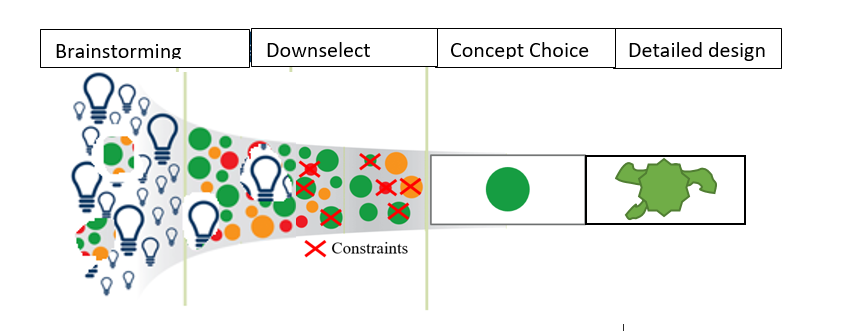
You can return to brainstorming at any point in this process as new information or inspiration becomes available. However, as detailed design for medical device product development progresses, it becomes prohibitively expensive in both time and material budget to deviate from the chosen concept. Even if you find a far superior design, you may be forced to take your original choice to market. Thus, there is significant value in generating better concepts before starting detailed design.
Here, we present a technique that can increase the quantity of relevant concepts generated during brainstorming. With a wider range of available concepts, an optimum concept or combination of concepts is more likely.
The first key to this technique is to classify the outputs of brainstorming into two distinct categories that we have named “Ideas” and “Concepts”.
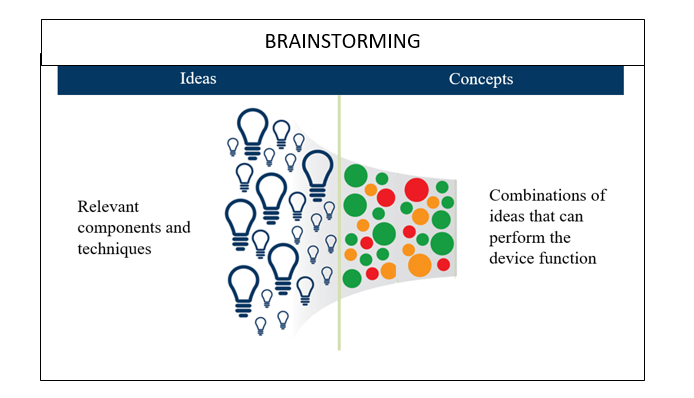
An “idea” is any component or technique that performs at least one function that the device requires. Ideas can be applicable to many different products and designs. A “concept” is a combination of ideas that can perform the overall function of the device. Concepts are tailored to your product requirements. Consider the example of a hand held drill. An idea might be using hand power as an input force. A concept would be hand power combined with a bevel gear connected to the drill bit.
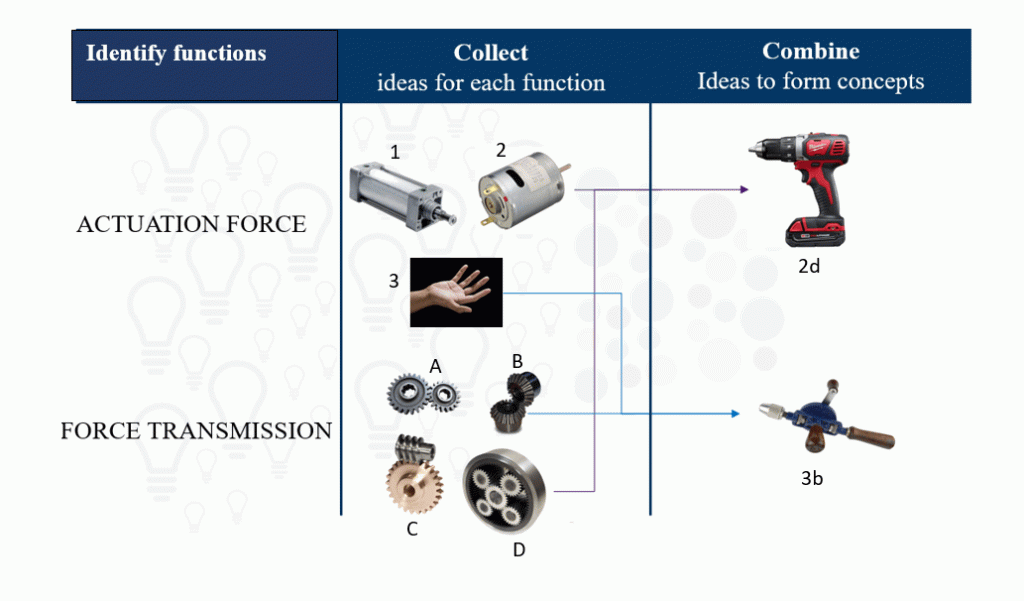
The second key to this technique is to identify the basic functions that the device must perform. Functions are the basic physical processes or features that are required to meet system requirements and specifications. What is the most general description of what you need to do the job? It can be helpful to randomly generate a few complete concepts and examine them to identify the basic device functions. As an example, the hand drill has two basic functions: 1) generating actuation force, and 2) transmitting that force to a rotating drill bit.
With idea/concept and functions in mind, the brainstorming technique has three steps: 1) identify device functions based on product requirements, 2) collect ideas relating to each device function, and 3) sequentially consider all combinations of the generated ideas to generate concepts.
Returning to the hand drill example, the figure below shows three ideas for actuation force (numbered 1 to 3) and four ideas for force transmission (labeled A to D). This gives a total of 3×4=12 possible concepts to consider. Most of these combinations are strange or un-interesting, like combination 1c, a pneumatically powered worm gear drill. However, combination 3B results in the base concept of a commonly available hand drill and combination 2D results in the base concept of a common battery operated hand drill.
Conclusion
This brainstorming method for medical device product development provides three significant benefits: 1) defining device functions provides a way to directly guide the brainstorming session with specs and requirements, 2) the list of device functions gives a logical framework to generate, document, and organize relevant ideas, and 3) sequentially combining ideas for each function provides a large number of concepts to consider. Give it a try! Maybe this technique will prove inspirational on your next medical device product development project.
Aaron Philippsen, is a StarFish Medical Mechanical Engineer, and recipient of the company’s Chris Denny Memorial Award for Innovation. You can watch Aaron in our Biotech Platform Design for Novel Medical Devices video below.