
Risk Management as a Design Tool in Medical Device Development
TL;DR
Risk management is frequently treated as a late-stage regulatory requirement rather than a core design discipline, despite driving real safety outcomes:
- FMEA and FTA identify and address failure modes before they reach patients: FMEA analyzes which failure modes affect patient or caregiver safety, while FTA maps the combinations of events that could produce a severe failure, together increasing both safety and reliability.
- ISO 14971’s Annex E hazard classes extend beyond the obvious categories: electrical, mechanical, biological, and functional failures are joined by use error, which injures more patients than device failure itself.
- Risk management functions as good engineering practice, not just regulatory compliance: confusing controls and poor ergonomics are design failures that a rigorous risk process should catch before reaching the market.
How do we define the quality of a medical device? What attributes cause us to come to the conclusion that a device is a “quality product”? The safety of the device, if mentioned at all, usually follows fit and finish, reliability and performance in the list of attributes we think of in connection with quality. The expectation that the device be safe for both the care giver and the patient is generally assumed as a requirement and expected as part of good engineering practice. Consequently the formal processes of risk management are often overlooked or left until late in the development process.
The tools for risk management and reliability engineering are very similar. The basic analysis tool is the Failure Mode Effects Analysis (FMEA). Just as it sounds, FMEA involves analyzing the various possible failure modes to determine which have an effect on the safety of the patient or caregiver. Once these failure modes are identified, mitigations are developed to eliminate or reduce the effects to an acceptable or justifiable level. If the risk is severe it is valuable to perform a Fault Tree Analysis (FTA) where all of the combinations of actions and events that can create the failure mode are documented in a flowchart. FTA is a tool originally created for improving reliability by identifying possible failure paths and redundancies. Used properly, both tools can greatly increase the safety and reliability of the design.
ISO 14971 is the standard for risk management in the development of medical devices. Annex E of the standard includes a list of typical hazards which can be used as classes of failure modes. The obvious ones are electrical, mechanical, biological and functional. Additionally use error is included, surprisingly, one of the most common types of failures. More patients are injured by the incorrect use of a medical device than the failure of the device itself. Anyone who has used more than one microwave, cell phone or computer application knows that not all user interfaces are created equally. Confusing controls and bad ergonomics should not survive the design process.
Risk management isn’t just a burdensome regulatory process it is good engineering practice. Good design is a term which can generate hours of discussion but at minimum it should result in a safe as well as an effective device.
Rob Keur is a former regulatory affairs expert at StarFish Medical. He follows his own advice for Startups & Founders.
Related Resources

Graphical mind maps created in online whiteboards offer a low-barrier, highly collaborative approach to early risk analysis in medical device development.

Medical device development is a complex process that requires careful attention at every stage.
When it comes to risk, the first thing to consider is the ISO 14971 standard. MDR and IVDR changes bring a new alignment in terms of risk.
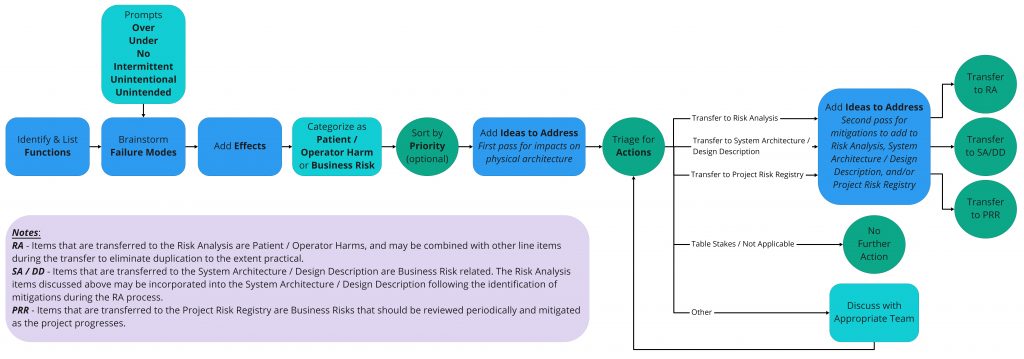
Using xFMEA as a Brainstorming Tool uncovers a powerful early-stage medical device design input tool used successfully at StarFish Medical.
Explore Our Services

Our multidisciplinary teams have all the in-house capabilities to transform your medical device from concept to final product.

Medical device design and development with a commercial launch focus. See how we support clinical trials and facilitate seamless tech transfers.

We help you navigate complex regulatory landscapes to achieve commercial success. Explore our integrated approach to quality and regulatory services.