

How Penicillin Works
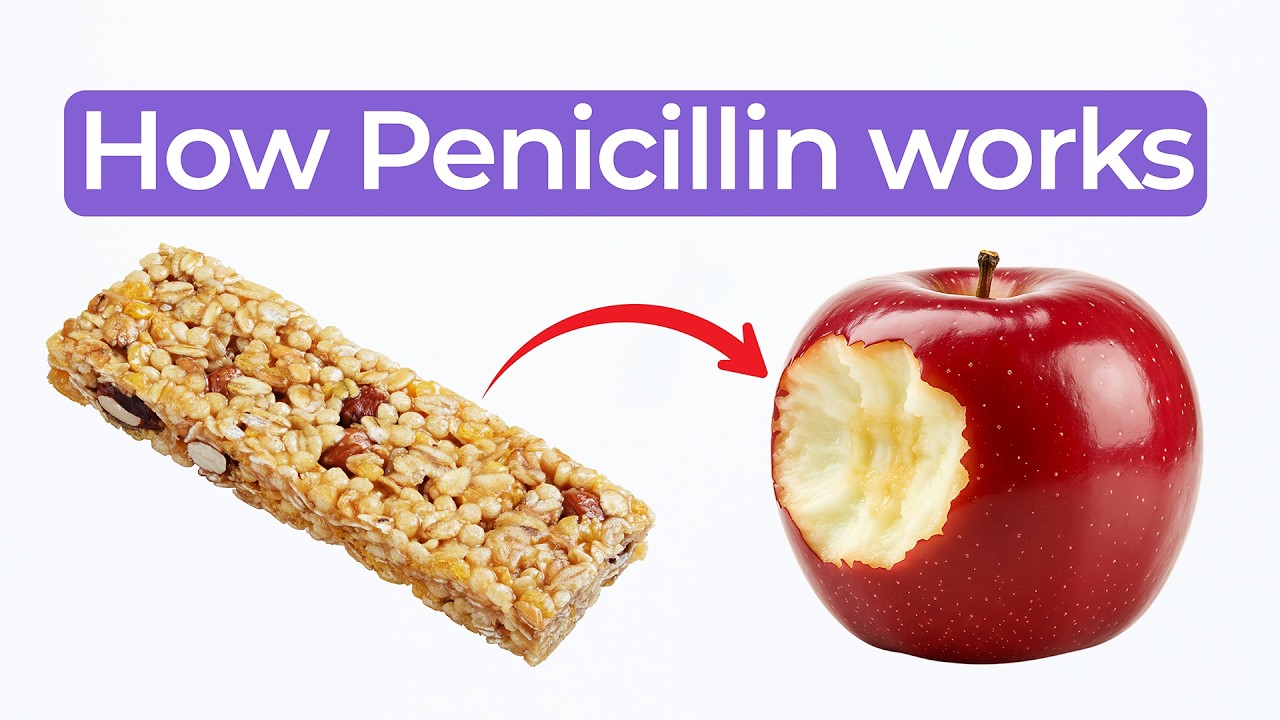
Antibiotics changed medicine forever, but many people still wonder how penicillin works at a biological level. In this Bio Break episode, Nick and Nigel break down the science behind one of the most important antibiotics ever discovered.
Using a simple lunch table demonstration, they explain how penicillin disrupts bacterial cell wall construction. The discussion also explores why bacteria depend on this process to survive and how resistance mechanisms can evolve.
The result is a clear explanation of how a small molecule can stop bacteria from maintaining their structural integrity.
How Penicillin Disrupts Bacterial Cell Walls
To understand how penicillin works, it helps to first look at how bacteria maintain their shape.
Bacteria are often rod shaped or spherical. Their structure is supported by a complex protective layer called peptidoglycan. This layer forms the rigid cell wall that prevents the bacteria from bursting due to internal pressure.
Special enzymes called penicillin binding proteins assemble this structure. These proteins link together the polysaccharides and peptides that form the peptidoglycan network. In simple terms, they act like builders that construct the bacterial wall piece by piece.
Penicillin interferes directly with this construction process.
The antibiotic contains a chemical feature called a beta lactam ring. This ring fits into the active site of the penicillin binding protein. Once bound, the enzyme can no longer perform its normal function.
As a result, the bacteria can no longer produce peptidoglycan effectively. Without a strong cell wall, the bacterial structure weakens and eventually breaks apart.
Penicillin Resistance in Bacteria
While penicillin was revolutionary, bacteria can develop ways to resist it.
Nick and Nigel describe two common resistance mechanisms.
The first involves changes to the penicillin binding protein itself. Mutations can alter the shape of the protein so that penicillin no longer fits properly. When this happens, the enzyme can continue building the cell wall even in the presence of the antibiotic.
The second resistance strategy involves beta lactamase enzymes. Some bacteria produce these enzymes specifically to destroy beta lactam antibiotics. Beta lactamases break down the antibiotic molecule before it can bind to the target protein.
Both strategies allow bacteria to survive exposure to drugs that once killed them.
Why Understanding Antibiotic Mechanisms Matters
Penicillin is approaching its 100 year anniversary since its discovery by Alexander Fleming. Despite its age, it remains a foundational example of how antibiotics work.
Understanding the mechanism behind antibiotics helps researchers develop new treatments and manage antibiotic resistance. It also shows how small molecular interactions can have large biological consequences.
In this Bio Break episode, Nick and Nigel demonstrate that even complex microbiology concepts can be explained with everyday objects and a simple analogy.
Enjoying Bio Break? Sign up to get new episodes sent to your inbox.
Related Resources
Theranostics combines diagnosis and therapy into a single targeting system, using one ligand to attach to two different radioactive payloads, one for imaging and one for treatment. It represents a significant shift in how cancer is being identified and treated. But the theranostics delivery workflow tells a different story.

Most medical devices were designed for clinical settings, not the patients and caregivers who increasingly rely on them at home. Here’s what good home-use device design actually requires.

How do you measure comfort in medical device design? Explore the tools, scales, and study design principles that turn a subjective experience into actionable design data.

Gathering health data has enormous value for spotting risks, improving care, and advancing science. The problem isn’t capturing the data. The problem is how we choose to present it and who we’re really serving when we do.