

How much does it cost to develop a medical device?
TL;DR
- Total funding to bring a Class II 510(k) medical device to market averages $30 million, based on a meta-analysis of industry surveys and public fundraising data.
- Development and engineering costs, including design, prototyping, testing, and documentation, typically represent $2 to $5 million of that total.
- The biggest cost drivers are regulatory pathway, clinical study requirements, and technology complexity. Devices requiring pivotal clinical trials can cost significantly more.
- Even the most minimal path to FDA clearance, with no real product design, costs over $150,000, making this a useful floor for any medical device budget estimate.
Executive Summary
The amount of total company funding to develop a Class II 510(k) cleared medical device is approximately $30 million. The development and engineering costs comprise approximately $2-5 million of this total. These funding amounts are derived from historical data, adjusting for inflation between ~2010 and 2024 and these values increase by approximately 40%. The estimate is built upon a meta-analysis of various references as well as our experiences in engaging with companies. Many factors influence these costs, including the need for clinical studies, regulatory pathway, and technology complexity. Refinement of these numbers requires a professional team to understand the technology, regulatory, and business opportunities.
The best approach in defining the answer to how much it costs to develop a medical device is to work with a multidisciplinary team, decompose the device into its specific design architecture elements, and then engage a team of experts to collaborate design solutions and provide estimates.
This bottom up approach ensures appropriate steps are being followed to create a successful product. A detailed plan is often a deliverable in early stage work and provides meaningful details for future project planning and investor engagement. This method is most useful when built on a foundation of device-specific needs and design.
This white paper answers:
- What are the nominal development costs and time needed for developing a medical device?
- How can a medical device development estimate be gleaned without going through detailed planning and forecasts, particularly if not all of the details have been determined?
- How can a start-up be confident that their medical device development cost projection is accurate?
- How can a start-up gain investor confidence in their cost projection?
Finding non-biased information on Medical Device Development cost projections is challenging. In preparing this paper, an audit of fifty Medical Device Design consultancies found zero white papers, blogs or articles on the subject of how much it costs to develop a device.
This paper applies four sources to answer what it costs to develop a medical device:
1. “FDA Impact on US Medical Technology Innovation – A Survey of Over 200 Medical Technology Companies”
Use this Survey as a benchmark. It is the most publicly recognized reference for cost projections for Medical Device Design Companies. The survey is all encompassing, with consideration to early stage innovation, clinical studies (if required), and regulatory clearance hurdles. Timelines are also included. The approach includes a large number of companies and was independently audited by Price Waterhouse Cooper.
2. Public Information
Analyze the costs associated with developing a medical device from available references. Generally, this information is pulled from public sources, and backed by experience-based understanding of the individual journeys.
3. Commercialization of Microfluidic Point-of Care Diagnostic Devices1
Use this white paper for Point of Care Diagnostic Devices. Funding analysis is drawn from public sources and compiled for consideration. The paper also includes technology discussions and narrative on the Claros Diagnostics journey.
4. The ‘No Design’ Product
Approximate the costs associated with developing a medical device from a paperwork and compliance perspective, through to regulatory clearance. Think of this as trying to get a ‘box of nothing’ through the required hurdles with absolutely no design activities. Not very exciting, but it is a good reference point to define a very minimum bar to have a medical device cleared for sale.
Most companies face the challenge of providing potential investors meaningful and detailed budgets that provide the total projected cost and time to develop their medical device. After all, everyone wants to know what their return on investment is going to be, how much money will need to be raised, and how long the development will take. For a start-up seeking funding, this is a complex task, and requires planning for unknown development challenges and opportunities, quantifying market size, projecting volumes, defining regulatory pathways and required testing, properly designing for the value proposition and reimbursement, and a whole host of other factors. All of these items will be at various stages of maturity and understanding when the plan and budget are being developed.
1. “FDA Impact on US Medical Technology Innovation
– A Survey of Over 200 Medical Technology Companies”
The goal of The FDA Impact on US Medical Technology Innovation survey was to quantify the money and time required to bring a device through to a salable product. This was a broad inquiry, with questions created with engagement from over 10 medical device associations and the FDA itself. The networks from Medical Device Manufacturers Association (MDMA) and National Venture Capital Association (NVCA) were leveraged for distribution, and a number of avenues (written, phone interviews, etc.) were available to collect responses.
Approximately 750 companies were contacted. Of these companies, approximately 200 responded to the questionnaire. The estimated total number of companies in the medical device industry at that time was approximately 1000. Upon collection, an independent analysis and verification of the data was completed by Price Waterhouse Coopers LLP.
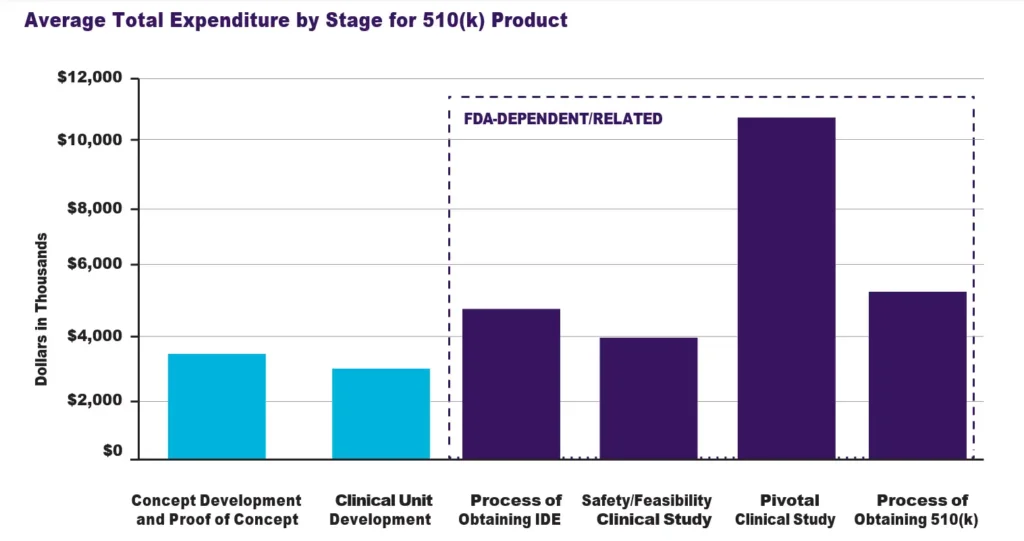
The key takeaway costs from this report are:
- The average total cost for participants to bring a 510(k) product from concept to clearance was approximately $31 million, with $24 million spent on FDA dependent and/or related activities. For a Class III Medical device going through a Premarket Approval (PMA), the average total cost from concept to approval was $94 million, with $75 million spent on stages linked to the FDA2.
- Analysing the percentages of these costs towards Concept Development and Proof of Concept for 510(k) cleared devices (~$3.8M) versus the total costs ($31M) indicates that, on average, this number is only 12%. However, this paper includes some reasonable costs for clinical studies, which, if not required, would increase this percentage closer to 30%, should clinical trials not be required. These numbers generally line up well with those provided in the section above.
- The key takeaway timelines for 510(k) clearance timing include 20 months for Concept Development and Proof of Concept work, 12 months of clinical unit development, and 40 months to 510(k) clearance. Additional timelines for PMA related submissions are provided in the report – and represent a very rough 50% increase in time.
The Industry Benchmark: $31M to Clearance
The average raised amount of total funding a 510(k) is $31M.
The average time for concept development and proof of concept work for a subset of medical device companies is 20 months.
2. Public Information
Using public information we determined how much funding they had raised. Companies were first filtered to include only those that have come to a meaningful place of design maturity with publicly available fundraising numbers. Information was collected through press releases and CrunchBase. One of the limitations of this method of data collection is that owner equity, non-dilutive governmental sources, tax reimbursements, and other forms of funding are often not captured. For these reasons, the amounts below are generally lower than actual funds raised, and in some instances, significantly lower. One additional caveat is that funding amounts are also not resolved on the percentages allocated to development, manufacturing ramp, regulatory, and overhead.
| Device | Design ‘Complete’ | Human Clinical Studies Required / Completed | Regulatory Clearance and Classification | Commercial Sales | Time from Initial to Final Fundraise During Development3 (years) | Amount Raised |
|---|---|---|---|---|---|---|
| Ablation Device | Yes | Yes / Yes | Yes – FDA Class III | Yes | 9.5 | $ 77 M |
| Vision Correction Device | Clinical Prototype | Yes / No | No – FDA Class III | No | 4.5 | $ 29.6 M |
| Eye Implant | Yes | Yes / In Progress | No – FDA Class III | No | 6 | $ 42 M |
| Optical Cart-Based System | Yes | Yes / Yes | Yes – FDA Class II | Pending | N/A | $ 5 M |
| Software as a Medical Device | Yes | No | Yes – FDA Class II | Yes | N/A | $ 3.2 M |
| Diagnostic Device | Yes | No | Yes – N/A | Yes | 5 | $ 24.6 M |
| Blood Treatment Device | Yes | Yes / Yes | Yes – FDA Class II | Pending | N/A | $ 500M4 |
| Point of Care (PoC) Blood Assessment | Yes | No | Yes – FDA Class II | Yes | 6.5 | $ 17.3 M |
| Light Therapy | Yes | No | Yes – FDA Class II | Yes | N/A | $ 14 M |
| Cell Processing | Yes | ? | Yes- N/A | Yes | N/A | $ 15 M |
| Novel Ultrasound Device | Yes | No | Yes | Yes | 5 | $ 20.5 M |
| Point of Care (PoC) Microfluidic Assay System | Yes | No | ? | Yes | 9 | $ 84 M |
| Average | 6 years | $ 25.5 M |
The above numbers indicate that the average raised amount of total funding is approximately $25.5 million.
Additional observations include:
- Companies requiring clinical trials often need to raise significantly more capital.
- Companies that have not yet achieved final regulatory clearance may still need to raise significant equity (to address clinical findings, complete manufacturing transfer and scale-up, etc.).
- The amount of total funds raised versus the development and engineering costs are two very different numbers.
Extracting the actual amount of development and engineering costs from these numbers is not publicly available information. The actual development costs also need to account for factors such as co-development, device maturity at the time of transfer, materials costs, regulatory and testing requirements, and a whole host of additional elements that quickly deviate from this top-down approach of a development cost summary.
Total medical device development and engineering costs is in the range of 10-30% of the total percentage of fundraised amounts. This number is based on the above examples and a review of projects we have worked on. Being more specific and pushing this analysis even further, for a medium complexity Class II Medical device, with a benchtop proven technology the total development costs are typically in the range of $2–5 million. This effort includes design, engineering, prototypes, testing, documentation, and ancillary activities in support of a submission and are not discriminatory towards internal or outsourced development. Obviously, every company and technology has a unique story that will differ from these projections – but it is still a useful reference point.
Public Data Tells the Same Story
The average raised amount of total funding is $25.5M. This estimate is heavily influenced by Device Classification and Clinical Study Needs. Additional key factors include device complexity, design maturity, and manufacturing needs.
The total cost for all product development is $2-5M.
3. Commercialization of Microfluidic Point-of Care Diagnostic Devices5
This review focused on the commercialization of Point-of-Care Diagnostic Devices. It covers Lab-on-Chip (LOC), lateral flow, and electrochemical detection devices that translate well to field use – and excludes lab-based systems such as next generation genomic sequencers, high throughput screening device and the like. A list of 32 companies were considered, with funding information collected through public sources, complimented with direct company clarifications in some instances. Analyzing those devices that received regulatory approval, and which funding information was available for, the average cost develop a Point of Care Diagnostics Device is $34M and took six years of time.
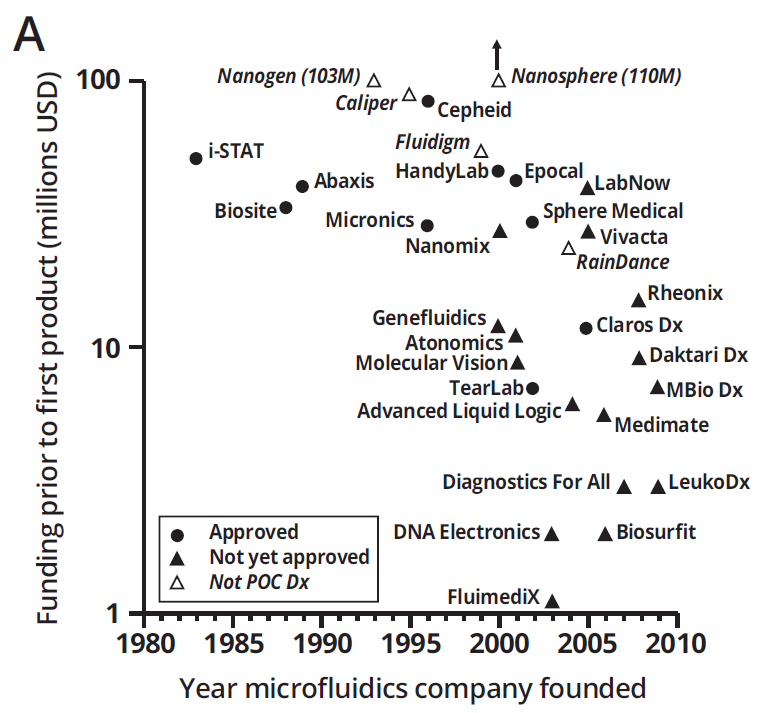
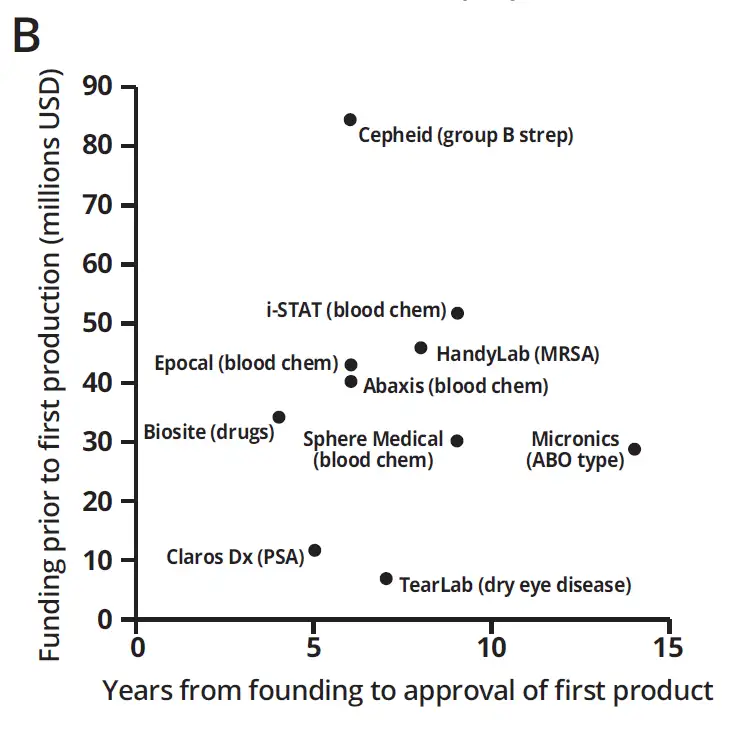
Point-of-Care Devices Run Higher: $34M Over Six Years
The average raised amount of total funding for a Point-of-Care device through to regulatory clearance is $34M.
4. The ‘No Design’ Product
This analysis is rather quixotic. It strips away development costs unique to a medical device and defines the cost to get a ‘box of nothing’ through standard design gates, prepare a documentation package, and clear the device through the FDA. It provides the minimum cost (e.g. documentation, testing, approvals) associated with medical device regulatory clearance.
For the purposes of this analysis, the following assumptions are made:
- The box is filled with air, which is available for free, in vast quantities. The box itself is cardboard and also available for free.
- A Design History File, Device Master Record, and Device History Record are all required.
- Some testing and measurements on the box of air are required – perhaps a quantitative optical density measurement to ensure that the air is clean and a shipping validation test to ensure that the air remains intact. This testing requires setup and needs to be appropriately documented.
- Minimal formative and summative evaluations are required, and no training is required – air is very easy to use.
- Labelling for the box, including instructions for use, are required.
- The company wishes to gain clearance in the US only.
- The device does not have a clear predicate, and has already been determined through a 513(g) that it is appropriate for a De Novo submission.
- The company plans to exit to a large strategic player once the device is cleared by the FDA.
- A Quality Management System is not explicitly required for US submission.
- The company will never be the formal Manufacturer of Record (MoR).
- The device will never be commercially sold by the founding company.
This scenario is an interesting thought experiment – partly because if air were to be considered a medical device, it should be a Class III life-sustaining device. It’s a good thing regulators have not caught onto this.
The following high-level efforts are anticipated in support of this box of nothing product’s clearance:
- Design Documentation and Testing – A Design History File (DHF) containing the following documents must be prepared: Design Plan, Product Requirements Document, Architecture Document, Risk Analysis (with some clinical input – perhaps with discussion on what ‘good air’ is), Design Specifications, and Verification and Validation (V&V) Test Plans as well as V&V Testing and Reporting (with equipment procured for the inline QC testing for our Optical Density measurement, as well as an abbreviated Human Factors and Usability Engineering (HFUE) File. Additionally, at least one formal Design Review must also be completed and documented. Signoff from the relevant parties for all documents must be complete. Additionally, a Device Master Record (DMR), and Device History Record (DHR) must be complete.
- Labelling and Instructions for Use – An appropriately designed label, and one-page Instructions for Use are developed.
- Submission Compilation – The documents are collated and provided in a format appropriate for FDA submission. This includes a Risk Benefit and Traceability Matrix built upon the DHF.
- Submission Costs – With reference to the FDA provided fee schedule, assume that the startup is a Small Business; a fee of approximately $25k is provided to the FDA. This example ignores other costs, such as the parallel 510(k) application.
User Fees for FY 20246
| Application Type | Standard Fee | Small Fee ‡ |
|---|---|---|
| 510(k)‡ | $21,760 | $5,440 |
| 513(g) | $6,528 | $3,264 |
| PMA, PDP, PMR, BLA | $483,560 | $120,890 |
| De Novo Classification Request | $145,068 | $36,267 |
| Panel-track Supplement | $386,848 | $96,712 |
| 180-Day Supplement | $72,534 | $18,134 |
| Real-Time Supplement | $33,849 | $8,462 |
| BLA Efficacy Supplement | $483,560 | $120,890 |
| 30-Day Notice | $7,737 | $3,869 |
| Annual Fee for Periodic Reporting on a Class III device (PMAs,PDPs, and PMRs) | $16,925 | $4,231 |
‡ 510(k) Fees: All types of 510(k)s (Traditional, Abbreviated, and Special) are subject to the user fee. However, there is no user fee for 510(k)s submitted to the FDA on behalf of an FDA-accredited third-party reviewer.
Based on the descriptions provided above, and with a whole host of additional unwritten assumptions (including that the FDA does not provide any feedback and provides clearance in 90 days), a very rough cost and time estimate for the work described above to a regulatory clearance, is $150k and 5 months duration. For a box of air.
Obviously, the scenario painted is fraught with problems, has no technical challenges, and is painfully straight forward. The complexity of having any technical features for a product provides a multiplier to these costs and timelines. However, as a reference point, the costs to get your medical device cleared by the FDA will be more than $150k.
The Cost Floor: $150K With No Product at All
The funding required to obtain a cleared medical device will be over $150k.
Conclusions
The question of how much time and money it will cost to develop a medical device is a challenging one to address. In this white paper we examined the costs associated with a ‘No Design’ Product, the differential between the cost to develop a device versus the total fundraised amounts, a review of an industry staple survey for the total raised funds for medical devices, and an article focused on Point of Care Diagnostic Devices. Based on these findings, we conclude that the total fundraised amounts for a Class II 510(k) cleared device will be on the order of $30 million, with the development and engineering costs being approximately $2-5 million. These funding amounts are based upon historical data. Adjusting for inflation between ~2010 and 2024 and these values increase by approximately 40%7.
Many companies are trying to figure out how far down the $30 million path they have gone, and how to move to the lower end of costs that other medical device companies have invested. The answers to these questions are unique to each project, and require deep understanding of the product, the maturity level of product requirements and device technology, company goals, and a host of additional factors.
StarFish Medical employs a proprietary High-level Program Plan methodology developed with input from Key Opinion Leaders, Subject Matter Experts and StarFish Engineering and Human Factors leaders to craft customized medical device development plans and budgets. This High-level Program Plan provides cost and time estimates considerate to the Medical Device Design Process8 and tailored to device and business needs. It may also include device design and usability considerations and concept sketches to ensure and align program vision to maximize client value and success.
Each company’s journey is unique. Contact us for a free consultation on how we can contribute to your medical device development success.
References
- “Commercialization of microfluidic point-of-care diagnostic devices” Curtis D. Chin, Vincent Linder and Samuel K. Sia. Received 5th December 2011, Accepted 25th January 2012 DOI: 10.1039/c2lc21204
- “FDA Impact of U.S. Medical Technology Innovation – A Survey of Over 200 Medical Technology Companies” Josh Makower, MD, Aabed Meer, Lyn Denend
- Accounts for time between fundraising rounds only. Development before and after fundraising not accounted for. Non public seed rounds and other funding sources may not be accounted for. Companies with one or no documented fundraising amounts are marked as N/A.
- Dollar amount is an estimate due to company name changes, etc. Excluded as an outlier in any of the data analysis.
- “Commercialization of microfluidic point-of-care diagnostic devices” Curtis D. Chin, Vincent Linder and Samuel K. Sia. Received 5th December 2011, Accepted 25th January 2012 DOI: 10.1039/c2lc21204
- https://www.fda.gov/industry/fda-user-fee-programs/medical-device-user-fee-amendments-mdufa
- https://www.in2013dollars.com/us/inflation/2010?amount=1
- https://starfishmedical.com/assets/Starfish-development-process-2013-aug_sml.jpg
Download Our Medical Device Cost Guide Now
Your Medical Device Cost Questions Answered
What is the average cost to develop a medical device?
Around $30M in total company funding for a Class II 510(k) device, with $2–5M for development and engineering.
What factors influence cost the most?
Regulatory pathway, clinical requirements, and technology complexity.
Why is this important for startups?
Accurate estimates build investor confidence and reduce the risk of costly delays.