
ALARP to AFAP, the MDR and ISO 14971:2019+A11:2021
TL;DR
The MDR’s alignment with ISO 14971:2019 tightens risk management expectations for medical device manufacturers, shifting the acceptable standard for reducing risk:
- The MDR emphasizes risk far more heavily than its predecessor directives: Risk is mentioned 243 times in EU MDR 2017/745, compared to a combined 69 mentions across the two prior medical device directives.
- AFAP removes economic impact as a factor in risk decisions: Unlike ALARP, which permits manufacturers to weigh cost against risk reduction, AFAP requires risk to be reduced as far as possible regardless of economic impact.
- ISO 14971:2019 relocated implementation guidance to a separate technical report: Hazard identification, risk concepts, and IVD-specific risk guidance now live in TR 24971:2020 rather than the standard itself, making future updates easier to issue.
The risk management approach
(Editor note: This blog updates the 2013 Vincent Crabtree, PhD article “How to Handle Medical Device Risk Management“). How to Handle Medical Device Risk Management and the change from ALARP to AFAPs ALARP (As Low As Reasonably Practicable) to AFAP (As Far As Possible) and medical device risk management has always been a tricky one. The nature of the products, their intended use, and the markets in which they are sold influences the approaches in controlling risk. When it comes to risk, the first thing to consider is the ISO 14971 standard. MDR and IVDR changes bring a new alignment in terms of risk.
The latest version of ISO 14971:2019+A11:2021 and the Medical Devices Regulation (EU) 2017/745 are linked and not referenced. EU MDR regulation has a very strong emphasis on risk management. Risk is mentioned 243 times in the regulation compared to a combined total of only 69 times in the two medical device directives — Active Implantable Medical Device 90/385/EEC (14 times) and Medical Device Directive 93/42/EEC (55 times).
Although ISO 14971 is not cited in the regulation, it is a documented harmonized standard in the Official Journal of the European Union. In January 2022, news emerged that this latest version of EN ISO 13485 has been officially harmonized under the MDR along with other standards.
Those who are new to the Regulatory Affairs field, should talk to experienced colleagues or read this previous ALARP-AFAP blog for insights.
How MDR is linked with ISO13485
In MDR in Annex I, Chapter l of the regulation exactly reflects risk management requirements of those in ISO 14971. Although the regulation does not specifically mention the medical device risk management standard ISO 14971, it does require compliance to harmonized standards. Recital 22 states “compliance with harmonized standards as defined in Regulation (EU) No 1025/2012 of the European Parliament and of the Council (2) should be a means for manufacturers to demonstrate conformity with the general safety and performance requirements and other legal requirements, such as those relating to quality and risk management, laid down in this Regulation.” Article 2 (70) defines a harmonized standard as “a European standard as defined in point (1)(c) of Article 2 of Regulation (EU) No 1025/2012”.
MDR requirements with respect to reducing risk
- Reduce risk as far as possible
- Eliminate risk (or reduce as far as possible)
- Minimize risk
- Remove risk (or reduce as far as possible)
- Remove risk (or minimize as far as possible)
- Reduce risk to the lowest possible
- Avoid risk to the lowest possible
In Clause 4.2 of ISO 14971:2019, Note 1 states that “The manufacturer’s policy for establishing criteria for risk acceptability can define the approaches to risk control: reducing risk as low as reasonably practicable, reducing risk as low as reasonably achievable, or reducing risk as far as possible without adversely affecting the benefit-risk ratio.”
This brings manufacturers to a point where they can manage risk based on all the requirements
Differences to keep in mind with regards to ALARP and AFAP
Conclusion
How to approach a final decision on risk management depends on company management, predominately based on regulatory requirement going forward.
ISO 14971:2019 provides a thorough process for manufacturers to identify medical device hazards, assess risks, control risks, and monitor the effectiveness of risk controls throughout the life of a device. The expectation is to reduce risk AFAP. It consists of 10 clauses and three annexes (informative) and is aligned with the general safety and performance requirements within the EU MDR and EU IVDR. It is a European harmonized standard and therefore represents the current state of the art. The EU commission explains that while the extent of the meaning of “as far as possible” still leaves open ambiguity, the risk management and risk mitigation under the MDR’s relies on safety concerns, e.g. “risk versus safety” benefits.
Rajeswari (Raje) Devanathan is a certified lead auditor and regulatory affairs professional with 20 years of experience in medical devices, IVD, combination products, and Biologics.
Virginia Anastassova, RAC, is a former Regulatory Affairs Manager/ Senior QA Specialist at StarFish Medical.
Images: Can Stock Photo / iqoncept
Related Resources

Graphical mind maps created in online whiteboards offer a low-barrier, highly collaborative approach to early risk analysis in medical device development.

Medical device development is a complex process that requires careful attention at every stage.
When it comes to risk, the first thing to consider is the ISO 14971 standard. MDR and IVDR changes bring a new alignment in terms of risk.
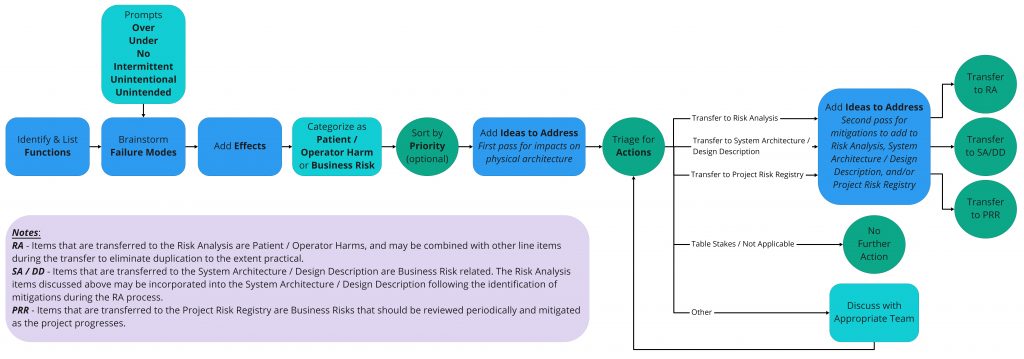
Using xFMEA as a Brainstorming Tool uncovers a powerful early-stage medical device design input tool used successfully at StarFish Medical.
Explore Our Services

Our multidisciplinary teams have all the in-house capabilities to transform your medical device from concept to final product.

Medical device design and development with a commercial launch focus. See how we support clinical trials and facilitate seamless tech transfers.

We help you navigate complex regulatory landscapes to achieve commercial success. Explore our integrated approach to quality and regulatory services.