
In a recent article for MD+DI, StarFish Medical Mechanical Engineer Nathan Müller examines when computational modelling and simulation, or CM&S, genuinely supports medical device simulation strategy and when it becomes a costly detour.
Müller’s central argument is that the most effective development teams don’t ask whether they can simulate something. They ask whether simulation will meaningfully improve their decision. When the answer is no, he notes, pursuing CM&S can waste time and capital, introduce false confidence, and delay outcomes that a simpler approach would have reached faster.
The article identifies seven conditions that signal simulation may not be the right tool at a given stage. These include situations where the governing physics are not yet well understood, where model inputs are uncertain or unmeasurable, where bench testing would be faster or cheaper, and where late-stage timelines leave no room to establish the model credibility required by standards such as ASME V&V 40. For each condition, Müller outlines a more appropriate first move, whether that is targeted characterization, empirical testing, or simplified calculations.
One of the more practically useful sections of the article addresses high-variability human-driven systems. Müller notes that user-applied forces, surgical techniques, and patient anatomical variation can produce a variability space too large for simulation to represent meaningfully without extensive probabilistic modelling. In these cases, human factors studies and usability testing are the right tools for bounding inputs before simulation becomes credible.
The article closes with a five-question checklist teams can use before committing to CM&S, covering physics understanding, input measurability, validation feasibility, cost-effectiveness, and decision relevance. Applied selectively and intentionally, Müller concludes, medical device simulation strategy delivers results that testing alone cannot.
Explore the full discussion by visiting the complete MD+DI article.
About StarFish Medical
StarFish Medical is a full-service medical device design, development, and specialty manufacturing company headquartered in Victoria, British Columbia, with additional offices in Toronto and Irvine, California.
StarFish Medical works with founder-led start-ups and global enterprises across North America that need to navigate the complexity of building and launching regulated medical technologies. The company combines product design and development with quality and regulatory expertise and manufacturing readiness to help teams move from early concept through commercialization and scaled production. Its experience includes diagnostics, drug delivery, surgical, therapy, and remote devices.
Founded in 1999, StarFish Medical has grown into Canada’s largest full-service medical device design, development, and commercialization partner. It operates as part of StarFish Holdings, which also includes ViVitro Labs, a global cardiovascular device testing company with facilities in Victoria and Marseille, France. In 2020, StarFish Medical led a multi-company Canadian team that updated the Winnipeg Ventilator to address COVID-19 supply chain and operational challenges.
Empowering Medtech Innovation®. starfishmedical.com
Contact Patrick Dean, Director of Marketing, for media inquiries.
Related Resources

We examine when computational modelling and simulation, or CM&S, genuinely supports medical device simulation strategy and when it becomes a costly detour.

This article traces the Pennes bioheat equation from its 1948 origins to modern multiscale approaches, explaining how engineers select the right level of modelling complexity across device categories.
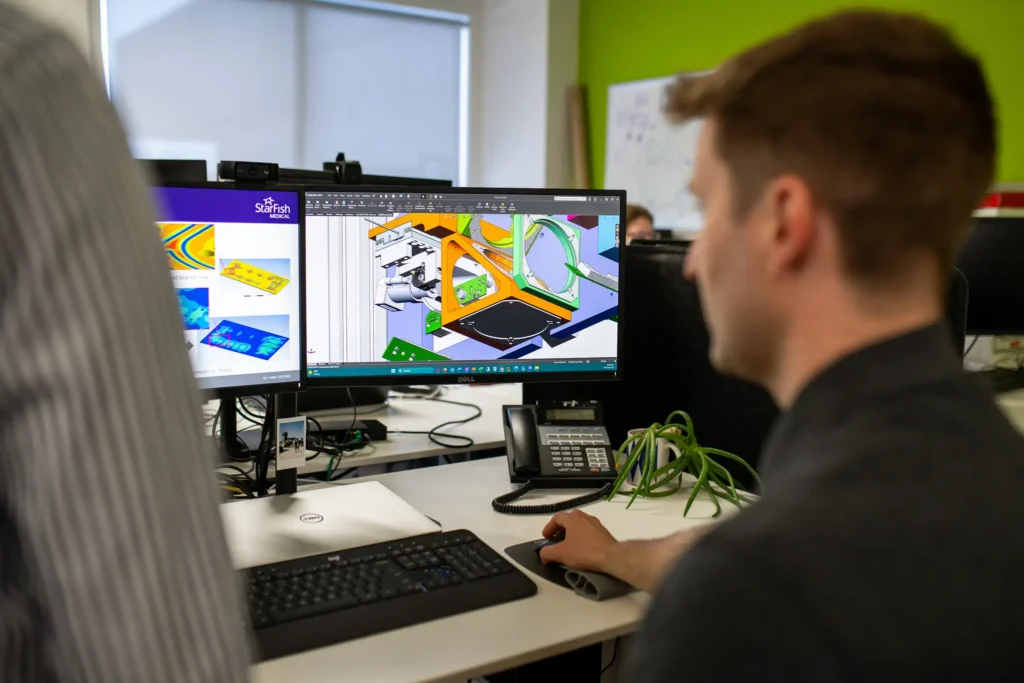
Designers and engineers today have no shortage of tools to improve designs, accelerate timelines, and meet cost targets. The challenge is knowing what to use and when.
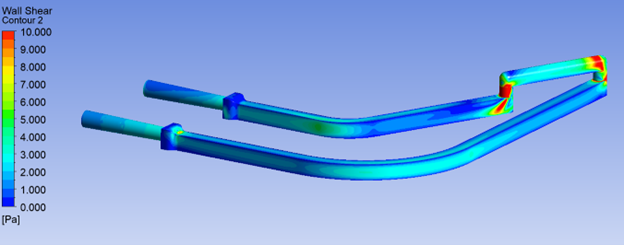
The impact of shear stress is critical to effectively design medical devices that handle biological fluids such as proteins or cell culture media. For example, non-physiological shear stress (NPSS) on blood is a key factor because hemolysis (cell rupture) could occur due to accumulated stress.